
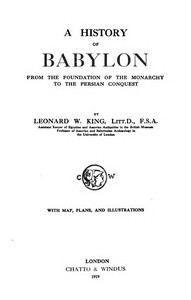
A History of Babylon, from the Foundation of the Monarchy to the Persian…
So, what's this book actually about? It's not a novel with a single plot, but the story it tells is just as gripping. L.W. King's 'A History of Babylon' is the biography of a city. It starts with its humble beginnings and follows its explosive rise to become the dominant power of Mesopotamia. The narrative follows the kings who built it up, like Hammurabi—the lawgiver—and Nebuchadnezzar II, who constructed the legendary Hanging Gardens. It shows how they conquered neighbors, managed vast empires, and created systems of administration that were centuries ahead of their time. Then, it doesn't shy away from the city's slow decline, the internal squabbles, and the final conquest by the Persian Empire. The 'conflict' is the city's constant fight for survival and supremacy in a brutal, competitive ancient world.
Why You Should Read It
I loved this book because it makes the ancient world feel immediate and human. King writes with a scholar's knowledge but a storyteller's heart. He doesn't just give you dates; he explains why things happened. Why did a certain law get written? What did a king's building projects say about his power? You get a real sense of the people—their ambitions, their gods, their daily struggles. The book shines when it connects ancient Babylonian achievements to our modern world, like how their base-60 math system is why we have 60 seconds in a minute. It turns distant history into a series of fascinating 'aha!' moments.
Final Verdict
This is a classic for a reason. It's perfect for curious readers who want to go deeper than a Wikipedia page or a documentary. If you enjoy authors like Tom Holland or Dan Carlin's podcasts, which make ancient history thrilling and relevant, you'll find a kindred spirit in L.W. King. Be aware, it was written over a century ago, so some archaeological details are outdated, but the core narrative and analysis remain powerful and engaging. It's for anyone who has ever looked at a map of the ancient world and asked, 'But how did they actually do that?'
Charles Jones
6 months agoSurprisingly enough, the pacing is just right, keeping you engaged. Truly inspiring.
Logan Miller
3 months agoWithout a doubt, the clarity of the writing makes this accessible. I would gladly recommend this title.
Betty Robinson
1 year agoVery helpful, thanks.
Richard Lopez
1 year agoThis is one of those stories where the emotional weight of the story is balanced perfectly. This story will stay with me.




Amanda Wright
6 months agoSurprisingly enough, it creates a vivid world that you simply do not want to leave. Truly inspiring.