About 31 minutes
Poems of West & East — A Reader’s Guide
Science Fiction Utopias
7,000 recorded words. 2 minutes difference from this book's estimate.
View Gutenberg source #30842
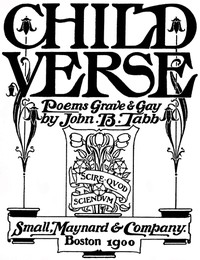
This digital edition of Child Verse: Poems Grave & Gay — Reading Notes is described by source-level measurements including 6,547 words, 29 min estimated reading time, and 2 detected text sections.
The text analysis averages about 23.1 words per sentence, while the detected sections provide another way to judge how the source is divided.
Project Gutenberg metadata also associates the work with “Children's poetry,” connecting these edition facts with the source record’s subject description.
Explore this collection
These alternatives are selected using recorded categories and estimated reading time.
About 31 minutes
Science Fiction Utopias
7,000 recorded words. 2 minutes difference from this book's estimate.
View Gutenberg source #30842About 24 minutes
Science Fiction Utopias
5,426 recorded words. 5 minutes difference from this book's estimate.
View Gutenberg source #44398About 22 minutes
Science Fiction Utopias
4,957 recorded words. 7 minutes difference from this book's estimate.
View Gutenberg source #40152Search stored excerpts and compare books → Choose by your preferences →
Choices use stored catalog measurements. Estimates vary with reading speed. A shared category is a catalog label, not a claim that two books have the same argument or literary quality.
Search reads excerpt text stored with this catalog and links to its associated Gutenberg record. The connection is stored in the site database; this tool does not recheck that every excerpt is word-for-word identical to that external record. Excerpt search does not cover every chapter and does not verify historical publication dates.
Catalog snapshot checked: 2026-09-25. Coverage: 97 public books, 97 available source excerpts.
Calculated from edition completeness, EPUB availability, text structure and catalogue metadata. Not a user rating.
Total of 100 points, scaled to a 2.5-5.0 range. Editions with an empty description or a missing EPUB file are not scored.
Public-domain source text
The source text is kept in the dedicated reader, separate from this catalogue record and its commentary.
John B. Tabb's Child Verse: Poems Grave & Gay (1899) opens with a note acknowledging that some poems previously appeared in periodicals like St. Nicholas and Harper's Young People. The collection's 78 short poems alternate between lighthearted nature observations and solemn religious reflections, a duality signaled by the title's "Grave & Gay." Tabb's verse is notably compressed: many poems run only four to eight lines, relying on tight rhyme and unexpected perspectives—such as the hare-bells as rabbit bells, or a butterfly as a "living blossom." The religious poems center on the Christ child, often seen through the eyes of animals or children, creating a gentle, intimate theology.
Tabb's poetic voice is marked by extreme economy. In "The Bobolink," he uses only six lines to praise the bird's song: "Your notes are few, / But sweet your song / As honey-dew." The brevity mirrors the bobolink's own sparse notes. Similarly, "The Bluebird" opens with a single line: "When God had made a host of..."—the ellipsis is Tabb's, leaving the reader to fill the color. This compression extends to religious poems: "The Child on Calvary" uses just eight lines to convey a child's perspective, with the line "The Cross is tall, / And I too small" capturing both physical and spiritual scale. Tabb avoids elaborate description, trusting the reader to feel the weight of what is left unsaid.
Many poems adopt the viewpoint of animals or natural objects, often with a playful logic. "Hare-bells" imagines the flowers as bells for rabbits, who "count the hours no more" when snow falls. "The Bee and the Blossoms" gives voice to a blossom that "breathes the love he cannot sing." In "Doctor Tumble-Bug," the dung beetle is treated with mock solemnity. These poems avoid sentimentality by grounding the fantasy in precise observation: the bobolink's "few" notes, the firefly's "sudden spark." The animal poems often serve as parables—"The Tax-Gatherer" (about a bee) and "A Spy" (a dragonfly) hint at moral lessons without stating them directly.
Approximately a third of the poems are explicitly religious, focusing on the infancy and childhood of Jesus. Tabb repeatedly emphasizes smallness and intimacy. In "The Lamb-Child," the newborn Christ blesses "each mother-sheep / And baby-lamb." "Hide-and-Seek" compares the finding of Jesus in the Temple to a child's game: "You hid your little self, dear Lord, / As other children do." The most striking is "The Child at Nazareth," where the speaker recalls measuring Jesus' height and seeing Him "stretch wide His arms" against a cypress tree—a foreshadowing of the crucifixion. Tabb's theology is tender, not doctrinal; the poems feel like whispered secrets.
Tabb favors short, regular stanzas—couplets, quatrains, and occasional six-line poems. His rhymes are often simple and exact ("song"/"long"), but he occasionally uses slant rhyme for effect: in "The Bobolink," "dew" rhymes with "you" in the next stanza. The meter is predominantly iambic, with frequent trimeter and dimeter lines that create a skipping, childlike rhythm. Poems like "A Duet" alternate between bird and blossom, using rhyme to link the two voices. The collection's structure moves from nature poems to religious ones, but the two modes intermingle: "A Lily of the Field" blends a biblical reference with a Marian compliment. Tabb's formal control ensures that even the simplest poem feels crafted.
Tabb's Child Verse rewards reading aloud, where its compact rhythms and surprising turns of phrase become most apparent. The poems are best approached not as a continuous narrative but as individual meditations, each built around a single image or idea. Readers may notice how Tabb's religious poems gain depth from the nature poems' precision, and vice versa. The collection offers a quiet, focused experience—one that respects both the child's imagination and the adult's sense of craft.
That rain kept drumming on the glass while I sat with Tabb’s Child Verse, noticing how his smallest creatures hummed with quiet purpose. His sparrows and snails felt less like lessons than prayers. When the light dimmed, I reached for Poems of West & East — A Reader’s Guide, and there it was: the same unhurried attention, the same sense that a landscape can hold a secret if you listen long enough.
Save your reaction, strongest insight, and memorable passage.