
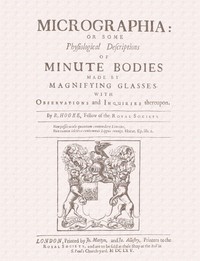
Micrographia by Robert Hooke
Okay, let's clear something up first. This isn't a novel. If you're looking for a plot with a hero and a villain, you won't find it here. But that doesn't mean there isn't a story. The story of Micrographia is the story of a man with a new toy, staring slack-jawed at a universe everyone else was walking on top of.
The Story
Robert Hooke, a brilliant and famously grumpy scientist in 17th-century London, got his hands on one of the best microscopes around. Instead of just peeking, he went on a systematic expedition. The 'plot' is his journey of observation. He starts with simple, man-made things: the jagged tip of a needle (which he finds is not sharp at all), the intricate weave of fine silk. Then he moves to nature: the stunning geometric pattern of a snowflake, the hairy legs of a louse, the compound eye of a fly. Each chapter is a new revelation. The climax? Perhaps his investigation of a common flea, rendered in a fold-out engraving so large and detailed it must have caused genuine shock. The resolution is his groundbreaking conclusion from looking at cork: that all living things are made of tiny rooms, which he calls 'cells.'
Why You Should Read It
You should read it for the sheer wonder. It’s easy to be jaded today, with HD nature documentaries a click away. Hooke had none of that. His awe is palpable on every page. He describes the mold on a book as a 'microscopical meadow,' full of tiny trees. He’s not just a scientist; he’s a poet of the very small. Reading this, you feel like you’re right there with him, gasping as he turns the focus knob. It’s also a lesson in careful seeing. Hooke teaches you to question your assumptions. Is a razor's edge smooth? Is a poppy seed simple? His book argues that truth requires looking deeper.
Final Verdict
This book is perfect for curious minds, fans of science history, artists, and anyone who needs a reminder of how strange and beautiful our world is. It’s not a cover-to-cover read for most; it’s a book to dip into. Open to a random engraving—the ant, the bee’s stinger, the silverfish—and let Hooke’s 350-year-old excitement infect you. It’s a foundational text of modern science that reads like a series of breathtaking postcards from the frontier of the unseen.




Ethan Sanchez
9 months agoThis is one of those stories where the depth of research presented here is truly commendable. I will read more from this author.