
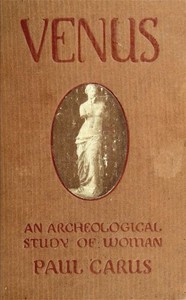
The Venus of Milo: an archeological study of the goddess of womanhood by Paul Carus
Most of us know the Venus de Milo as that elegant, armless statue from ancient Greece, a universal symbol of beauty. Paul Carus's book asks us to forget what we think we know. He starts with the statue's discovery in 1820 and its immediate fame, then pulls back the curtain. Why is her pose so specific? What do the remaining fragments of her attributes tell us? Carus pieces together evidence from archaeology, comparative religion, and philosophy. He travels through time, connecting the Greek Aphrodite to older goddesses like Ishtar and Astarte, showing how this figure evolved. The core of his study is a radical re-interpretation: the Venus of Milo isn't merely about romantic love or physical allure. He argues she represents the complete and sacred ideal of womanhood—encompassing motherhood, creative force, celestial power, and profound wisdom. The 'plot' is his intellectual journey to restore her original meaning, which he believes was lost or simplified over the ages.
Why You Should Read It
This book surprised me. I expected a stuffy academic paper, but Carus writes with a quiet passion that's contagious. He isn't just cataloging facts; he's on a mission to give this silent stone woman her voice back. The best parts are when he 'reads' the statue's body language—the twist of her torso, the drape of her robe—as if they are sentences in a lost language. It turns an inanimate object into a character with a story. You start seeing her not as a broken relic, but as a powerful statement. It made me think about how history is written by what survives, and more importantly, by how we choose to interpret those fragments. Carus challenges us to look deeper, to question the labels museums give us.
Final Verdict
This is a perfect read for anyone who loves a good historical mystery, art lovers who want more context than a museum placard, or people curious about ancient myths and goddess cultures. It's not a light beach read—you have to meet it halfway—but the payoff is a richer, more fascinating perspective on a global icon. If you've ever stood before a famous work of art and felt there was a story you weren't being told, Carus is your guide. He hands you a magnifying glass and asks, 'Now, what do you really see?'










Sarah Flores
8 months agoJust what I was looking for.