About 52 minutes
Poems — Themes and Context
Adventure Picaresque Fiction
11,892 recorded words. 3 minutes difference from this book's estimate.
View Gutenberg source #52796
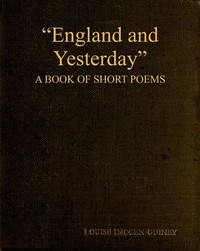
"England and Yesterday": A Book of Short Poems — Story, Setting & Ideas can be approached with a clearer sense of reading commitment from its source measurements: 11,125 words, 49 min estimated reading time, and 56 detected text sections.
The text analysis averages about 20.7 words per sentence, while the detected sections provide another way to judge how the source is divided.
Project Gutenberg metadata also associates the work with “American poetry -- 19th century,” connecting these edition facts with the source record’s subject description.
Explore this collection
These alternatives are selected using recorded categories and estimated reading time.
About 52 minutes
Adventure Picaresque Fiction
11,892 recorded words. 3 minutes difference from this book's estimate.
View Gutenberg source #52796About 44 minutes
Adventure Picaresque Fiction
10,045 recorded words. 5 minutes difference from this book's estimate.
View Gutenberg source #35667About 54 minutes
Adventure Picaresque Fiction
12,239 recorded words. 5 minutes difference from this book's estimate.
View Gutenberg source #48306Search stored excerpts and compare books → Choose by your preferences →
Choices use stored catalog measurements. Estimates vary with reading speed. A shared category is a catalog label, not a claim that two books have the same argument or literary quality.
Search reads excerpt text stored with this catalog and links to its associated Gutenberg record. The connection is stored in the site database; this tool does not recheck that every excerpt is word-for-word identical to that external record. Excerpt search does not cover every chapter and does not verify historical publication dates.
Catalog snapshot checked: 2026-09-25. Coverage: 97 public books, 97 available source excerpts.
Calculated from edition completeness, EPUB availability, text structure and catalogue metadata. Not a user rating.
Total of 100 points, scaled to a 2.5-5.0 range. Editions with an empty description or a missing EPUB file are not scored.
Public-domain source text
The source text is kept in the dedicated reader, separate from this catalogue record and its commentary.
The collection opens with a sequence of twelve sonnets set in London, each anchored to a specific location—Westminster Abbey, Hyde Park, the British Museum. Guiney's voice in these poems is formal, even ceremonial, as in the opening line 'Holy of England!' and the invocation to be 'seal'd with her a marriage and a peace / Eternal.' Yet the same sonnet sequence includes 'Fog,' where the city's atmosphere is rendered as 'bodily water passing in a sigh,' a more fluid, unsettling image. This tension between the monumental and the ephemeral runs through the volume.
The poems are grouped by geography and genre: London sonnets, Oxford sonnets, then a section of 'Lyrics' on varied subjects, and finally 'Lines on Various Fly-Leaves,' brief epitaphs and addresses. The arrangement itself suggests a movement from public, architectural spaces to more personal, occasional verses.
Guiney frequently reaches for words that feel deliberately old-fashioned: 'consort' (as a verb), 'erewhile,' 'leal,' 'architrave.' In 'On First Entering Westminster Abbey,' she writes 'since my light is short / And faint, O rather by the sun anew / Of timeless passion set my dial true.' The syntax is inverted and compressed, demanding careful reading. In 'The Yew-Tree,' the phrase 'the yew-tree paternal, / The yew-tree devout' pairs a familial term with a religious one, creating a strange, almost anthropomorphic stillness. This archaism is not uniform, however; in 'In a London Street,' the language shifts to a more direct, almost colloquial observation: 'The cabs in firefly dartings, the barrel-organ's air.'
The collection moves between sonnet forms—tight, fourteen-line structures with regular rhyme schemes—and looser lyric forms. The sonnets themselves vary in pace: 'Fog' uses enjambment to create a sense of dissolution ('The towery vista sinks upon the eye, / As if it heard the horns of Jericho'), while 'The Lights of London' (not fully excerpted) likely offers a more measured, descriptive rhythm. In the lyrics, 'Of Joan's Youth' employs a refrain ('No more, no more') and a questioning tone ('Ah, say how winds in flooded grass / Unmoor the rose'), which slows the reading. 'Shropshire Landscape' builds a cumulative, almost incantatory rhythm through repeated color imagery ('Beauty incarnadine!') and a final, striking simile: 'Like a queen, battle-wroth, / Upon a vermeil saddle-cloth, / The three-spired city rides.'
Certain images recur across the sections. Light appears as a fragile, often threatened presence: in 'Fog,' the morning sun is 'suck[ed] in' by shadows; in 'In a London Street,' the speaker claims 'Mine is the clotted sunshine, a bubble in the sky.' Fog and mist are not merely atmospheric but carry moral weight—'City of Stains!'—and are linked to dissolution. Stone and architecture provide a counterpoint: Westminster Abbey, the Minster, the 'old church tower' in 'The Yew-Tree.' These structures are addressed as enduring witnesses, as in 'Passing the Minster': 'Praise to thine awful beauty, praise / And peace, O warden of my ways!' The speaker often seeks to be 'fixed' or 'sealed' into these stone settings, suggesting a desire for permanence against the transience of 'secular love' and 'transitory things.'
Readers may find it useful to read the London and Oxford sonnets as paired sequences, noting how the same formal constraints yield different moods—from the public, historical weight of Westminster to the more personal, reflective tone of 'A December Walk' or 'Undertones at Magdalen.' The later lyrics and fly-leaf verses offer a more varied pace; some, like 'The Graham Tartan to a Graham,' are direct addresses, while others, like 'A Footnote to a Famous Lyric,' are compressed allusions. Pay attention to how Guiney's diction shifts between the ceremonial and the plain, and how her recurring images of light, fog, and stone create a cohesive but not uniform texture.
I was leafing through England and Yesterday again, pausing at the Thames sonnets, and something in their quiet, unhurried cadence reminded me of another volume I once kept by my window. The way the old poems hold their breath, then release a thought slowly—it felt like the same patient hand at work in Selected Poems — Inside the Classic, turning memory into a shape that doesn’t need to rush.
Build a private reading journal entry for this title.









