About 54 minutes
Selected Poems — Inside the Classic
Adventure Picaresque Fiction
12,239 recorded words. 2 minutes difference from this book's estimate.
View Gutenberg source #48306
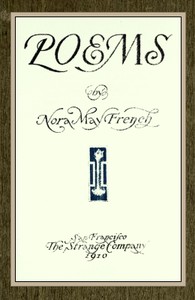
The catalog record for Poems — Themes and Context provides practical reading context through 11,892 words, 52 min estimated reading time, and 3 detected text sections.
The text analysis averages about 22.7 words per sentence, while the detected sections provide another way to judge how the source is divided.
Project Gutenberg metadata also associates the work with “American poetry,” connecting these edition facts with the source record’s subject description.
Explore this collection
These alternatives are selected using recorded categories and estimated reading time.
About 54 minutes
Adventure Picaresque Fiction
12,239 recorded words. 2 minutes difference from this book's estimate.
View Gutenberg source #48306About 55 minutes
Adventure Picaresque Fiction
12,568 recorded words. 3 minutes difference from this book's estimate.
View Gutenberg source #50376About 49 minutes
Adventure Picaresque Fiction
11,125 recorded words. 3 minutes difference from this book's estimate.
View Gutenberg source #52533Search stored excerpts and compare books → Choose by your preferences →
Choices use stored catalog measurements. Estimates vary with reading speed. A shared category is a catalog label, not a claim that two books have the same argument or literary quality.
Search reads excerpt text stored with this catalog and links to its associated Gutenberg record. The connection is stored in the site database; this tool does not recheck that every excerpt is word-for-word identical to that external record. Excerpt search does not cover every chapter and does not verify historical publication dates.
Catalog snapshot checked: 2026-09-25. Coverage: 97 public books, 97 available source excerpts.
Calculated from edition completeness, EPUB availability, text structure and catalogue metadata. Not a user rating.
Total of 100 points, scaled to a 2.5-5.0 range. Editions with an empty description or a missing EPUB file are not scored.
Public-domain source text
The source text is kept in the dedicated reader, separate from this catalogue record and its commentary.
Nora May French's Poems, published three years after her death at age twenty-six, opens with a sonnet that immediately establishes a distinctive voice. In 'The Outer Gate,' life speaks directly to the speaker, offering 'shining ways' yet admitting it cannot bar 'the outer door'—a threshold that leads to death. The poem's formal structure and direct address set a pattern for the collection: French often uses apostrophe and tight rhyme schemes to frame intimate, sometimes confrontational dialogues between the self and abstract forces.
The volume's 71 poems shift between sonnets, lyrics, and narrative sequences like 'The Spanish Girl,' which spans three parts. Across these forms, French returns to natural details—rain that 'was brown upon the earth,' a 'mournful little wind,' wistaria in bloom—as anchors for emotional states. The voice ranges from the declarative ('I follow at thy will') to the hesitant ('I only know they pleased me well, and died'), creating a rhythm of assertion and withdrawal.
French frequently writes poems that speak to a specific 'you'—life, a beloved, a past self, or an unnamed presence. In 'The Outer Gate,' life is personified and addressed as 'mother'; in 'Change,' the speaker turns to a beloved with 'Beloved, have I turned indeed so cold?' This technique creates an immediate, almost dramatic tension, as if the poem is a fragment of a larger conversation. The listener shifts between poems: sometimes it is a human figure, sometimes an abstraction like 'Memory' or 'the year.' In 'Growth,' the trellis is addressed as 'little trellis,' then the speaker pivots to describe her own 'wild sap stirring.' This variability in addressee keeps the reader uncertain about who is being spoken to, reinforcing a sense of private, unfinished exchange.
The effect is amplified by French's use of rhetorical questions. 'How can I answer when you bid me sing?' she asks in 'Change,' and in 'Best-Loved,' 'Was any hue preferred above the rest?' These questions are not answered within the poems; they hang, unresolved, contributing to a voice that is both assertive and vulnerable.
French's natural world is not decorative but functional: it mirrors and measures internal states. Rain appears in multiple poems, each time with a different quality. In 'Rain,' it is 'grey before it fell,' then 'brown upon the earth,' and finally 'mirror to the sky'—a progression from anticipation to aftermath to reflection. The poem 'Between Two Rains' (not excerpted fully) suggests a pause in weather that corresponds to a pause in feeling. Flowers are similarly precise: a 'sweeter violet chosen from the rest,' a rose that is 'a day's delight at best,' wistaria that 'clusters perfect as of old.'
These images often carry a double weight. The wistaria in 'Wistaria' is both a present bloom and a trigger for memory: 'My heart has ached with it today.' The poppy field (title only) and the 'yellow straw' in 'Two Spendthrift Kings' evoke abundance, but the speaker's tone is often elegiac. French uses the natural cycle—budding, blooming, fading—to articulate change that is neither celebrated nor mourned outright, but observed with a kind of resigned clarity.
The collection's pacing varies noticeably between shorter lyrics and longer narrative poems. The early sonnets and quatrains move quickly, with end-stopped lines and regular meter. 'The Outer Gate' uses a tight Petrarchan structure; 'Rain' uses alternating tetrameter and trimeter to create a falling rhythm. But in poems like 'My Nook,' the pace slows. The speaker recalls a childhood hiding place in long, conversational lines: 'Oh, half way up the hill it was, where one might sit leaf-hidden.' The present tense of memory ('I could not take my trouble there') contrasts with the brisk, declarative openings of earlier poems.
This shift in pace is most evident in 'The Spanish Girl,' a three-part narrative that occupies roughly a third of the volume. The excerpts show a more expansive, story-driven voice, with descriptive passages and dialogue. The change from lyric compression to narrative extension suggests French was experimenting with form, using the longer sequence to explore character and setting in ways the shorter poems resist. Readers may find that the collection's emotional weight accumulates not in any single poem but in the contrast between these speeds.
French's voice is notable for its refusal to settle into a single mood. She moves from the imperative ('Go from me if thou wilt') to the wistful ('I think its heart had never seen the light') within a few pages. Readers attentive to shifts in address, image, and line length will find a poet working through formal constraints to capture something elusive. The collection rewards rereading: what first appears as a simple lyric often reveals a second, more hesitant layer. Approach these poems as a series of experiments in voice, not as a unified statement.
There are moments in Poems — Themes and Context where rain feels like a held breath, and I keep returning to that quiet. Later, browsing Oxford poetry, 1920 — Edition Insights, I noticed how differently those later voices treat the same threshold—less private, more measured. It made me wonder what Nora might have written, had she reached that particular autumn. The pages stay open, unanswered.
Your answers remain private and are stored only in this browser.









