About 194 minutes
Popular British Ballads, Ancient and Modern, Vol. 3 (of 4) — Key Ideas to Explore
Fantasy Juvenile Worlds
44,405 recorded words. 6 minutes difference from this book's estimate.
View Gutenberg source #45243
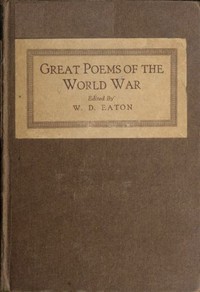
For Great Poems of the World War — Key Ideas to Explore, the stored edition analysis reports 45,981 words, 3 hr 20 min estimated reading time, and 11 detected text sections.
The text analysis averages about 21.5 words per sentence, while the detected sections provide another way to judge how the source is divided.
Project Gutenberg metadata also associates the work with “World War, 1914-1918 -- Poetry,” connecting these edition facts with the source record’s subject description.
Explore this collection
These alternatives are selected using recorded categories and estimated reading time.
About 194 minutes
Fantasy Juvenile Worlds
44,405 recorded words. 6 minutes difference from this book's estimate.
View Gutenberg source #45243About 124 minutes
Fantasy Juvenile Worlds
28,508 recorded words. 76 minutes difference from this book's estimate.
View Gutenberg source #52623About 120 minutes
Fantasy Juvenile Worlds
27,515 recorded words. 80 minutes difference from this book's estimate.
View Gutenberg source #39614Search stored excerpts and compare books → Choose by your preferences →
Choices use stored catalog measurements. Estimates vary with reading speed. A shared category is a catalog label, not a claim that two books have the same argument or literary quality.
Search reads excerpt text stored with this catalog and links to its associated Gutenberg record. The connection is stored in the site database; this tool does not recheck that every excerpt is word-for-word identical to that external record. Excerpt search does not cover every chapter and does not verify historical publication dates.
Catalog snapshot checked: 2026-09-25. Coverage: 97 public books, 97 available source excerpts.
Calculated from edition completeness, EPUB availability, text structure and catalogue metadata. Not a user rating.
Total of 100 points, scaled to a 2.5-5.0 range. Editions with an empty description or a missing EPUB file are not scored.
Public-domain source text
The source text is kept in the dedicated reader, separate from this catalogue record and its commentary.
W. D. Eaton's Great Poems of the World War opens with a striking epigraph by Lieutenant Gilbert Waterhouse: “Between the hedges of the centuries / A thousand phantom armies go and come, / While Reason whispers as each marches past, / ‘This is the last of wars—this is the last!’” This couplet sets a tone of ironic hope that recurs throughout the anthology. The preface frames the war as a “blast” that “human reason could not have foreglimpsed,” and positions the poems as voices from the dark—voices of “lamentation, of home and love and hope and heroism.” Eaton explicitly states that the selection prioritizes poems suitable for recitation, especially in schools, and includes “captain notes” with sidelights on topics and personalities.
The anthology juxtaposes poems of grand, apocalyptic rhetoric with intimate, domestic scenes. The preface itself uses heightened language: “the winds of destruction swirled and roared around the monstrous welter.” Yet the collection includes Edgar A. Guest’s “The Lonely Garden,” which wonders what the trees, birds, and roses will say now that a boy has “marched away.” The poem’s dialect (“An’ knew him as the little lad”) and focus on a single child’s absence offer a quiet counterpoint to the epic scale. Similarly, Alfred W. Pollard’s “The British Army of 1914” adopts a biblical, psalm-like structure (“Let us praise God for the Dead”), while P. H. B. L.’s “Morituri Te Salutant” blends chivalric imagery (“Knights—we have found the lady of our love”) with a sense of national awakening. This range—from the cosmic to the personal—suggests that the war was experienced both as a world-historical event and as a disruption of everyday life.
Eaton’s preface acknowledges that the war’s “epic has not been written” because “the time is too near us, the motive too deep, the theme too vast.” Instead, the anthology offers “voices” that express the war’s spirit with “personal, passionate fidelity.” This framing implies that poetry can capture emotional truth even when a comprehensive narrative is impossible. The poems themselves often foreground the act of witnessing: in “The Lonely Garden,” the speaker imagines how nature will react to the boy’s absence; in “Morituri Te Salutant,” the soldiers address their country directly. Yet the collection also includes poems that grapple with the inadequacy of language—one sonnet asks, “Can earth o’ercome the evil with the good?” and calls for “the pure light of Freedom’s afterglow.” The tension between the desire to memorialize and the recognition that words may fail is a recurring undercurrent.
Eaton explicitly designed the anthology for oral performance: “There is no better way to stir the mind or fix the memory than by spoken words of beauty in rhythmic cadence, especially in schools.” This pedagogical aim influences the selection of poems, which favor strong rhythms, refrains, and clear emotional arcs. For instance, “The British Army of 1914” uses repetitive, litany-like lines (“Let us praise God for the Dead”), while “The Lonely Garden” employs a simple, ballad-like structure with repeated questions. The notes, described as “helpful sidelights,” further support recitation by providing context. By prioritizing performability, Eaton shapes how the war is remembered—not as a chaotic, unrepresentable event, but as a series of poignant, teachable moments. The anthology thus becomes a tool for collective memory, one that emphasizes heroism, sacrifice, and the continuity of everyday life.
Readers approaching Great Poems of the World War should attend to the editorial choices that shape the collection: the poems selected for recitation, the notes that frame them, and the preface’s explicit acknowledgment of the war’s inexpressible scale. The anthology offers a curated view of how poets and editors sought to make sense of the conflict in its immediate aftermath, balancing lament with hope, the personal with the national. It rewards attention to the contrasts between poems—between the apocalyptic and the domestic, the rhetorical and the plainspoken—and to the ways in which the collection itself becomes a act of memory-making.
Holding this anthology, I remembered my grandfather’s war diary—pressed flowers between pages about mud and stars. The same quiet ache surfaced years later in Ardours and Endurances; Also, A Faun's Holiday & Poems and Phantasies — Text and Context, where nature keeps its own vigil beside loss. Some poems don’t argue; they just stay, like the light on a kitchen table.
Answer a few questions and save a private reflection on this device.









