About 55 minutes
The Divine Vision, and Other Poems — Story, Setting & Ideas
Science Fiction Utopias
12,620 recorded words. 2 minutes difference from this book's estimate.
View Gutenberg source #36913
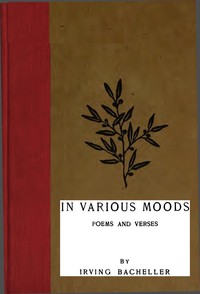
This digital edition of In Various Moods: Poems and Verses — A Closer Reading is described by source-level measurements including 12,038 words, 53 min estimated reading time, and 3 detected text sections.
The text analysis averages about 24.7 words per sentence, while the detected sections provide another way to judge how the source is divided.
Project Gutenberg metadata also associates the work with “American poetry,” connecting these edition facts with the source record’s subject description.
Explore this collection
These alternatives are selected using recorded categories and estimated reading time.
About 55 minutes
Science Fiction Utopias
12,620 recorded words. 2 minutes difference from this book's estimate.
View Gutenberg source #36913About 55 minutes
Science Fiction Utopias
12,443 recorded words. 2 minutes difference from this book's estimate.
View Gutenberg source #50429About 50 minutes
Science Fiction Utopias
11,323 recorded words. 3 minutes difference from this book's estimate.
View Gutenberg source #49277Search stored excerpts and compare books → Choose by your preferences →
Choices use stored catalog measurements. Estimates vary with reading speed. A shared category is a catalog label, not a claim that two books have the same argument or literary quality.
Search reads excerpt text stored with this catalog and links to its associated Gutenberg record. The connection is stored in the site database; this tool does not recheck that every excerpt is word-for-word identical to that external record. Excerpt search does not cover every chapter and does not verify historical publication dates.
Catalog snapshot checked: 2026-09-25. Coverage: 97 public books, 97 available source excerpts.
Calculated from edition completeness, EPUB availability, text structure and catalogue metadata. Not a user rating.
Total of 100 points, scaled to a 2.5-5.0 range. Editions with an empty description or a missing EPUB file are not scored.
Public-domain source text
The source text is kept in the dedicated reader, separate from this catalogue record and its commentary.
Irving Bacheller's In Various Moods: Poems and Verses (1900) opens with a formal ode for a university anniversary and closes with a dialect poem about a hunting prank, signaling the collection's deliberate range. The table of contents lists twenty-one titles, including tributes to a dead classmate, a slumber ship, and a ven'son-tree. Bacheller shifts between standard English and rustic dialect, between earnest sentiment and comic tension. The excerpts show a poet attentive to sound—the creak of a paddle, the squeak of an Adam's apple—and to the physicality of rural life: fields, canoes, and the call of flocks. This is not a uniform volume but a showcase of contrasts.
The opening poem, “The Sowers,” written for the fiftieth anniversary of St. Lawrence University, establishes a solemn, elevated tone. Bacheller invokes “the hills that lift the distant plain” and “the college hall—the spirit of its throngs,” linking landscape to learning. The poem dwells on sacrifice: parents who “gave their strength in toil that racked their bones” so that children might gain “the power of learning wedded to their brawn.” The speaker imagines laying a “worthy prize” before them, a harvest of their own “word and deed.” The language is deliberate and reverent, with repeated images of sowing and reaping. “The New World,” read before Phi Beta Kappa in 1902, continues this public, aspirational voice. These poems position Bacheller as a poet of institutions and ideals, concerned with inheritance and the moral purpose of education.
In sharp contrast, poems like “Whisperin' Bill” and “Him an' Me” use rustic dialect and dramatic situations. “Whisperin' Bill” recounts a hunting trip where the speaker deliberately fails to shoot a deer, prolonging his companion's anxiety. The poem builds tension through physical detail: “I could hear his Adam's apple go a-squeakin' up an' down.” The companion's frustration erupts in comic fury: “He had panthers in his bosom, he had horns upon his mind.” The punchline—that the speaker has “ketched a pome” instead of game—turns the poem into a self-aware joke about poetry itself. “A Voice of the Fields” blends dialect with lyricism: “The red was on the clover an' the blue was in the sky.” The speaker recalls a lost love through the call “Co' day! Co' day!” These poems show Bacheller experimenting with voice, humor, and the vernacular, often at the expense of his own characters.
Across the excerpts, Bacheller returns to specific sensory details. Water appears as “dark or touched with light of gold,” as a river “slow, or swift so like the flowing years.” In the dialect poems, the canoe “shook an' shivered” with the speaker's tension. Sound is carefully rendered: the “harping breeze,” the “squeakin'” of a throat, the echo of a call in wooded hills. The poet often pairs abstract emotion with concrete physicality—grief is a “mountain of his woe,” anger makes fur “riz up behind.” These patterns suggest a writer attuned to the music of language, whether in formal meter or colloquial rhythm. The juxtaposition of high and low, serious and comic, is not accidental; it is the organizing principle of a collection that defines itself by its moods.
Readers approaching In Various Moods should expect a poet who moves between registers without apology. The formal poems reward attention to their imagery of cultivation and legacy; the dialect pieces demand a ear for pacing and irony. Bacheller does not resolve the tension between these voices—he lets them stand side by side. The collection is best read not as a unified statement but as a series of experiments, each poem a different key.
That rainy afternoon, In Various Moods kept pulling me between its rustic voices and formal odes, until the verse about a boy leaving his farm for college left me unsettled—that ache of ambition and loss. I set it down, and my hand drifted to a forgotten shelf, landing on Oxford poetry, 1921 — Key Ideas to Explore. Its quieter, post-war tone felt like the same conversation, years later.
Your answers remain private and are stored only in this browser.









