About 54 minutes
Selected Poems — Inside the Classic
Adventure Picaresque Fiction
12,239 recorded words. 1 minutes difference from this book's estimate.
View Gutenberg source #48306
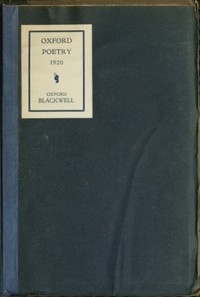
Oxford poetry, 1920 — Edition Insights can be approached with a clearer sense of reading commitment from its source measurements: 12,568 words, 55 min estimated reading time, and 3 detected text sections.
The text analysis averages about 22.2 words per sentence, while the detected sections provide another way to judge how the source is divided.
Project Gutenberg metadata also associates the work with “English poetry -- 20th century,” connecting these edition facts with the source record’s subject description.
Explore this collection
These alternatives are selected using recorded categories and estimated reading time.
About 54 minutes
Adventure Picaresque Fiction
12,239 recorded words. 1 minutes difference from this book's estimate.
View Gutenberg source #48306About 57 minutes
Adventure Picaresque Fiction
13,092 recorded words. 2 minutes difference from this book's estimate.
View Gutenberg source #54058About 52 minutes
Adventure Picaresque Fiction
11,892 recorded words. 3 minutes difference from this book's estimate.
View Gutenberg source #52796Search stored excerpts and compare books → Choose by your preferences →
Choices use stored catalog measurements. Estimates vary with reading speed. A shared category is a catalog label, not a claim that two books have the same argument or literary quality.
Search reads excerpt text stored with this catalog and links to its associated Gutenberg record. The connection is stored in the site database; this tool does not recheck that every excerpt is word-for-word identical to that external record. Excerpt search does not cover every chapter and does not verify historical publication dates.
Catalog snapshot checked: 2026-09-25. Coverage: 97 public books, 97 available source excerpts.
Calculated from edition completeness, EPUB availability, text structure and catalogue metadata. Not a user rating.
Total of 100 points, scaled to a 2.5-5.0 range. Editions with an empty description or a missing EPUB file are not scored.
Public-domain source text
The source text is kept in the dedicated reader, separate from this catalogue record and its commentary.
The anthology Oxford Poetry 1920, edited by Vera Brittain, C. H. B. Kitchin, and Alan Porter, presents a snapshot of verse from Oxford undergraduates and recent graduates in the immediate aftermath of the First World War. The collection includes contributions from well-known figures such as Edmund Blunden and Robert Graves, alongside lesser-known poets. The poems range from pastoral meditations to stark confrontations with modernity, and the editors have arranged them to highlight contrasts in voice and pace.
One striking feature is the variation in narrative speed: some poems unfold slowly, with meticulous description, while others accelerate into urgent, fragmented lines. This editorial note examines how the poets manipulate tempo and tone, drawing on specific examples from the text.
Several poems in the collection adopt a measured, observant pace, dwelling on natural details. Edmund Blunden's "Sheet Lightning" opens with a leisurely scene: "When on the green the rag-tag game had stopt, / And red the lights through alehouse curtains glowed." The rhythm is unhurried, matching the evening atmosphere. However, the poem soon shifts into a more urgent register when describing the lightning itself: "Working and whickering; snake-like; winged and clawed." The sudden burst of active verbs and sharp imagery disrupts the earlier calm, creating a tension between stillness and motion.
Similarly, in Alan Porter's "A Far Country," the narrative voice adopts a contemplative tone, but the pace quickens during moments of action, such as the detailed description of catching a trout: "Sudden touch of cold, wet silk. Now flesh be one with brain!" The long, flowing sentences give way to short, imperative clauses, mirroring the suddenness of the catch. These shifts in pace are not merely stylistic; they reflect a thematic concern with the intrusion of violence or urgency into peaceful settings.
The shadow of the First World War hangs over many poems, and the editors have included pieces that directly address postwar disillusionment. Vera Brittain's "The Lament of the Demobilized" uses a clipped, almost conversational rhythm to convey bitterness: "We who have seen the world's great age go down / In blood and fire, what have we left to say?" The short lines and rhetorical question create a sense of exhausted resignation. The pace is steady but heavy, as if each word is weighed down by experience.
In contrast, Edgell Rickword's "Advice to a Girl from the Wars" adopts a faster, more cynical tone, with irregular line lengths and abrupt enjambments: "When the boys come back / They will not be the same." The poem's staccato rhythm mirrors the fragmentation of postwar identity. The editors' choice to place such poems alongside more lyrical works emphasizes the range of responses to conflict, from elegiac to sardonic.
Several poets in the anthology blend classical or mythic references with modern settings, creating a jarring shift in tone. C. H. B. Kitchin's "Opening Scene from 'Amphitryon'" employs formal, dramatic language, but the excerpt breaks off before the action unfolds, leaving the reader with a sense of suspended time. The pace is deliberately slow, with elaborate speeches and stage directions.
Roy Campbell's "Bongwi's Theology" takes a different approach, using a colloquial, almost jaunty rhythm to discuss serious themes: "The baboon said, 'God is a great baboon.'" The abrupt shift from high to low register is disorienting, and the poem's quick tempo undercuts any pretension. This clash of styles is a hallmark of the collection, as the editors juxtapose traditional forms with experimental voices. The result is an anthology that feels both rooted in literary history and responsive to the fractured sensibilities of the postwar era.
Readers approaching Oxford Poetry 1920 should pay attention to how each poem establishes its tempo—whether through line length, syntax, or imagery—and how that tempo shifts over the course of the piece. The editors have curated a collection that rewards close reading of these formal choices. Rather than seeking a unified theme, consider how the poets use pace to evoke mood, tension, or irony. This anthology offers a valuable record of a generation finding its voice in the wake of profound change.
I remember that Oxford anthology, its pages holding Graves and Blunden between wartime shadows and quiet fields. Years later, I found a similar patience in Poems — Inside the Classic, a soft echo of that same searching tone. They sit together now, old friends on my shelf, sharing a whispered understanding.
A brief reflection can help important ideas stay with you longer.









