About 61 minutes
Etain the Beloved, and Other Poems — Reading Companion
Historical Psychological Social Fiction
14,018 recorded words. 1 minutes difference from this book's estimate.
View Gutenberg source #38135
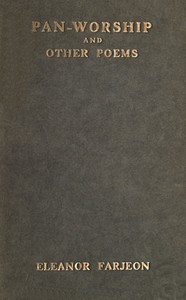
Before opening Pan-Worship, and Other Poems — Text and Context, the edition data offers a quick orientation: 14,132 words, 1 hr 2 min estimated reading time, and 19 detected text sections.
The text analysis averages about 20.7 words per sentence, while the detected sections provide another way to judge how the source is divided.
Project Gutenberg metadata also associates the work with “English poetry -- 20th century,” connecting these edition facts with the source record’s subject description.
Explore this collection
These alternatives are selected using recorded categories and estimated reading time.
About 61 minutes
Historical Psychological Social Fiction
14,018 recorded words. 1 minutes difference from this book's estimate.
View Gutenberg source #38135About 66 minutes
Historical Psychological Social Fiction
15,048 recorded words. 4 minutes difference from this book's estimate.
View Gutenberg source #40344About 56 minutes
Historical Psychological Social Fiction
12,826 recorded words. 6 minutes difference from this book's estimate.
View Gutenberg source #50815Search stored excerpts and compare books → Choose by your preferences →
Choices use stored catalog measurements. Estimates vary with reading speed. A shared category is a catalog label, not a claim that two books have the same argument or literary quality.
Search reads excerpt text stored with this catalog and links to its associated Gutenberg record. The connection is stored in the site database; this tool does not recheck that every excerpt is word-for-word identical to that external record. Excerpt search does not cover every chapter and does not verify historical publication dates.
Catalog snapshot checked: 2026-09-25. Coverage: 97 public books, 97 available source excerpts.
Calculated from edition completeness, EPUB availability, text structure and catalogue metadata. Not a user rating.
Total of 100 points, scaled to a 2.5-5.0 range. Editions with an empty description or a missing EPUB file are not scored.
Public-domain source text
The source text is kept in the dedicated reader, separate from this catalogue record and its commentary.
Eleanor Farjeon's Pan-Worship, and Other Poems (1908) opens with a speaker kneeling at a ruined shrine, addressing a stone Pan whose 'pointed ears / Are keen and prick'd with old remember'd sounds.' This image sets the collection's central tension: a craving for lost pagan vitality set against the awareness of its irrevocable decay. Throughout the volume, Farjeon returns to moments of threshold—twilight, the last night of a season, the instant a petal falls—where presence and absence meet. The poems do not simply mourn; they listen for echoes, watch for shadows, and find in nature's cycles a pattern of both loss and continuity.
The title poem establishes a pattern of address to a deity who is both present and absent. The speaker describes Pan's image as 'time-defacèd,' crumbling 'to its complete oblivion,' yet the god's ears remain alert, and his smile 'derides / Pan's lost dominion.' This paradox—worship directed at a god who mocks his own worship—recurs in subtler forms. In 'The Mysterious Forest,' the forest itself becomes a living presence that 'breathes' and 'waits,' while in 'The Old Grey Queen,' a personified nature figure endures beyond human memory. Farjeon does not offer a simple revival of classical myth; instead, she dramatizes the act of reaching backward, knowing the reach will fall short. The speaker's cry 'All my breast aches with longing for the past!' is answered only by the spring's indifferent bubbling.
Several poems explore love as a shared secret that is never truly private. In 'Shadows,' the speaker discovers that their secluded bower is crowded with the ghosts of former lovers: 'More lovers than I could count.' These shadowy figures watch, touch, and even kiss the speaker, who feels 'soft breath enwreathe / My brow' and 'lips were laid to mine'—yet these are not the beloved's. The poem ends with a chilling gap: the beloved thinks the speaker has kissed them, but 'I had not kissed you, dear.' Similarly, 'The Last Night' imagines the lovers' own future as shades haunting the same garden 'after a million years.' Farjeon uses the natural setting—a pond, a sundial, rose-petals—as a stage where every gesture has been performed before and will be performed again.
Farjeon's diction consistently favors words of fading, falling, and fleeting: 'crumbles,' 'evanescent,' 'deflowered,' 'waning,' 'spent.' In 'The Waning Year,' two small sights—'one single leaf grown dry and golden' and a blossom that 'fell instantly deflowered to earth's brown bosom'—trigger a premonition of departure: 'Dear heart, we must begone ere many mornings.' The nature songs gathered under 'A Sheaf of Nature-Songs' (dated Overstrand, 1905) admit their own inadequacy: 'some lack rhythm and metre, / And none of the songs is sweeter ... as the thing / Which was the fountain and spring.' This self-awareness distinguishes Farjeon's pastoral mode from mere description; the poems are conscious of being secondary to the world they attempt to capture.
Readers approaching Pan-Worship, and Other Poems will find a voice that is both ardent and self-questioning. Farjeon's speakers are never fully at ease in the present; they listen for what is almost gone. The collection rewards attention to its recurring images—broken toadstools, spider's webs undone, bright green rings in grass—and to the way it frames love, nature, and belief as things already haunted by their own endings. These are poems that ask to be read slowly, with an ear for the silence between lines.
Sometimes I reread Pan-Worship and feel that ache of remembering something I never quite had—and it makes me reach for Poems of Adoration — A Closer Reading, which holds that same quiet reverence, but softer, like a hand resting on a familiar page. Both know how longing and gratitude can sit together, wearing the same old coat.
Save your reaction, strongest insight, and memorable passage.









