About 43 minutes
Poems: Pastoral and Psalm — Reading Companion
Historical Psychological Social Fiction
9,859 recorded words. 2 minutes difference from this book's estimate.
View Gutenberg source #51367
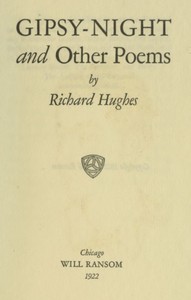
Gipsy-Night, and Other Poems — A Closer Reading can be approached with a clearer sense of reading commitment from its source measurements: 9,362 words, 41 min estimated reading time, and 2 detected text sections.
The text analysis averages about 25.7 words per sentence, while the detected sections provide another way to judge how the source is divided.
Project Gutenberg metadata also associates the work with “Poetry,” connecting these edition facts with the source record’s subject description.
Explore this collection
These alternatives are selected using recorded categories and estimated reading time.
About 43 minutes
Historical Psychological Social Fiction
9,859 recorded words. 2 minutes difference from this book's estimate.
View Gutenberg source #51367About 38 minutes
Historical Psychological Social Fiction
8,606 recorded words. 3 minutes difference from this book's estimate.
View Gutenberg source #38898About 53 minutes
Historical Psychological Social Fiction
12,094 recorded words. 12 minutes difference from this book's estimate.
View Gutenberg source #59474Search stored excerpts and compare books → Choose by your preferences →
Choices use stored catalog measurements. Estimates vary with reading speed. A shared category is a catalog label, not a claim that two books have the same argument or literary quality.
Search reads excerpt text stored with this catalog and links to its associated Gutenberg record. The connection is stored in the site database; this tool does not recheck that every excerpt is word-for-word identical to that external record. Excerpt search does not cover every chapter and does not verify historical publication dates.
Catalog snapshot checked: 2026-09-25. Coverage: 97 public books, 97 available source excerpts.
Calculated from edition completeness, EPUB availability, text structure and catalogue metadata. Not a user rating.
Total of 100 points, scaled to a 2.5-5.0 range. Editions with an empty description or a missing EPUB file are not scored.
Public-domain source text
The source text is kept in the dedicated reader, separate from this catalogue record and its commentary.
Richard Hughes's Gipsy-Night, and Other Poems (1922) opens with a preface that directly engages Robert Graves's psychoanalytic theory of poetry, arguing that poetry stems not only from neurosis but also from human drives for communication and pattern-making. This theoretical framing sets the collection apart from typical debut volumes, signaling Hughes's self-conscious craft. The poems that follow often inhabit a liminal space between the domestic and the mythic, as in 'Old Cat Care' where a cottage's tight door and small window keep out personified worries, or 'The Rolling Saint' where a murdered hermit's ghost demands a stone from every passerby. Hughes's voice is by turns wry, stark, and lyrical, with a preference for concrete imagery over abstraction.
Hughes's preface is a rare prose statement that directly informs the collection's design. He summarizes Graves's argument that poetry functions like dreams, resolving emotional deadlocks through symbolism, but warns against making the 'symbolic test' the sole criterion. Instead, Hughes insists on poetry as communication and pattern-making, a 'partial truth' that resists reduction. This is not a dry academic note: it frames the poems as deliberate artifacts, not automatic therapy. The preface also reveals Hughes's awareness of contemporary literary debates, citing The Athenæum, London Mercury, and The Dial as venues where these pieces first appeared. Readers encountering the poems after this preface may notice how Hughes balances symbolic resonance with formal play—irregular meters, internal rhymes, and abrupt line breaks that disrupt any easy dreamlike flow.
Several poems anchor themselves in specific Welsh or English settings, but the landscapes are never merely picturesque. In 'Weald,' a 'leaden night' and 'film-eyed moon' create a scene of oppressive stillness, broken only by 'evil-minded cats' and 'the slow twist of water round a snag.' The speaker declares it 'the most unhappy night' since Hecuba or Bethlehem, yet admits 'there is no reason for unhappiness'—only the mood of the sky. 'The Rolling Saint' is set 'Under the crags of Teiriwch,' where 'God has left the bony earth / Just as it was begun.' Here, a woman who lived ninety years on bilberries and moss is murdered by robbers, rolled down the hill in a barrel, and buried under a single stone. The poem turns into a folk-like warning: passersby must add a stone or face the ghost. Hughes treats the supernatural with matter-of-fact gravity, never explaining or moralizing.
Hughes moves between lyric compression and narrative balladry. 'The Jumping-Bean' is a short, playful address to a bean with a maggot inside, dancing in sunlight—then a sudden shift: 'Liest thou stark, stiff, / There in thy bed? / Weep then a dirge for him: / Poor Bean's dead!' The poem's tone veers from delight to mock-elegy, undercutting any simple anthropomorphism. 'Old Cat Care' uses a nursery-rhyme structure—'Green-eyed Care / May prowl and glare'—to assert domestic security against personified worries. 'Cottager is given the Bird' (1921) appears to continue this folk vein, though the excerpt cuts off. Hughes's forms are rarely regular: he favors short lines, variable stanza lengths, and off-rhymes that keep the reader slightly off-balance, as in 'Gipsy-Night' where 'hoofs' rhymes with 'roofs' and 'knees' with 'trees.' This formal restlessness matches the collection's thematic concern with boundaries between sanity and superstition, comfort and threat.
Hughes's poems reward attention to their small, precise details—the 'uncomfortable hooving of midnight cows,' the 'ballast of round thunder' in a cloud, the 'snub, be-whiskered nose' of Care. The preface offers a key, but the poems themselves resist easy decoding. Readers may find it useful to read each poem aloud, noting where rhythm breaks or shifts, and to consider how Hughes uses folk motifs not as decoration but as structures for exploring psychological states. The collection is brief, but its echoes linger.
That rainy afternoon, I kept returning to Hughes’s “Weald,” its stubborn silence and rooted unease. The preface’s Freudian talk made me restless, somehow. When the light failed, I set it down and picked up a thin volume I’d been ignoring — Poems — Story, Setting & Ideas — and found the same shadows, only more patient, quietly waiting there.
Use these questions to collect your thoughts before moving on.