About 79 minutes
Fanny, with Other Poems — Themes and Context
Adventure Picaresque Fiction
18,153 recorded words. 2 minutes difference from this book's estimate.
View Gutenberg source #34762
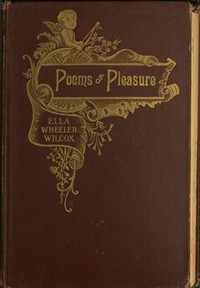
For Poems of Pleasure — Background and Themes, the stored edition analysis reports 18,481 words, 1 hr 21 min estimated reading time, and 4 detected text sections.
The text analysis averages about 21.9 words per sentence, while the detected sections provide another way to judge how the source is divided.
Project Gutenberg metadata also associates the work with “American poetry -- 19th century,” connecting these edition facts with the source record’s subject description.
Explore this collection
These alternatives are selected using recorded categories and estimated reading time.
About 79 minutes
Adventure Picaresque Fiction
18,153 recorded words. 2 minutes difference from this book's estimate.
View Gutenberg source #34762About 75 minutes
Adventure Picaresque Fiction
17,156 recorded words. 6 minutes difference from this book's estimate.
View Gutenberg source #32146About 89 minutes
Adventure Picaresque Fiction
20,399 recorded words. 8 minutes difference from this book's estimate.
View Gutenberg source #41076Search stored excerpts and compare books → Choose by your preferences →
Choices use stored catalog measurements. Estimates vary with reading speed. A shared category is a catalog label, not a claim that two books have the same argument or literary quality.
Search reads excerpt text stored with this catalog and links to its associated Gutenberg record. The connection is stored in the site database; this tool does not recheck that every excerpt is word-for-word identical to that external record. Excerpt search does not cover every chapter and does not verify historical publication dates.
Catalog snapshot checked: 2026-09-25. Coverage: 97 public books, 97 available source excerpts.
Calculated from edition completeness, EPUB availability, text structure and catalogue metadata. Not a user rating.
Total of 100 points, scaled to a 2.5-5.0 range. Editions with an empty description or a missing EPUB file are not scored.
Public-domain source text
The source text is kept in the dedicated reader, separate from this catalogue record and its commentary.
Ella Wheeler Wilcox's Poems of Pleasure opens with a declaration of total emotional surrender. In 'Surrender,' the speaker describes love as a cosmic collision that 'shook, thrilled, and startled' body and soul, leaving 'old ties, old dreams, old aims, all torn apart.' The poem's first-person voice and intimate address to 'Love' establish a pattern of direct, confessional lyricism that runs through the collection. Wilcox pairs this intensity with a mythological fable, 'The Birth of the Opal,' where a sunbeam and moonbeam unite to produce a gem. These opening poems signal a dual interest: the personal drama of passion and the symbolic transformation of natural elements into art.
The first section, 'Passional,' treats love as a force that reorders reality. In 'Surrender,' the speaker claims that after meeting her beloved, 'the earth seemed something foreign and afar, / And we two, sovereigns dwelling in a star.' The poem uses astronomical metaphors—planets, stars, chaos—to elevate personal emotion to a universal scale. Wilcox's speaker presents love as a kind of religion: 'Cold Reason stood aside / With folded arms to let a grand Love enter / In my Soul's secret chamber to abide.' The language of sacrifice and worship ('I consumed my past,' 'Complete surrender') frames romantic devotion as both ecstatic and totalizing. Readers should note how Wilcox sustains this elevated register through the section, using exclamation marks and rhythmic repetition to mimic emotional intensity.
In the 'Philosophical' section, Wilcox shifts from ecstatic surrender to reflective acceptance. The poem 'The Room Beneath the Rafters' contrasts her present luxury with a remembered childhood trundle bed, where 'resinous knots in roof boards made / A frescoing of light and shade.' This concrete, sensory detail grounds the speaker's nostalgia in a specific space. Later, in an untitled poem about dancing, the speaker acknowledges that 'though storms of tears have watered the years,' life remains 'a cup worth drinking.' The tone becomes measured: 'There is deeper pleasure in the slower measure / That Time's grand orchestra now is playing.' Wilcox uses musical imagery to suggest that maturity brings a quieter but richer satisfaction, a clear departure from the earlier passionate outbursts.
The 'Miscellaneous' section includes 'A Plea,' a poem that directly addresses 'Columbia'—a personification of the United States. Wilcox criticizes open immigration, urging the nation to 'shut the door in their faces— / Until they have learned to behave!' The poem's tone is angry and protective: 'Our hearts are grown wrathful and jealous / Toward those who have outraged your trust.' This political voice contrasts sharply with the intimate confessions of the 'Passional' poems. Wilcox uses the same direct address ('Columbia, large-hearted and tender') but now to a nation rather than a lover. The poem reveals her willingness to engage with public issues, though readers should note that this excerpt does not show whether the collection offers a consistent political stance or a single moment of commentary.
Across all sections, Wilcox returns to natural elements—sunbeams, moonbeams, opals, poplars, mud wasps, martin birds—as both setting and symbol. In 'The Birth of the Opal,' the gem is 'the child' of sun and moon, blending their qualities. In 'The Room Beneath the Rafters,' the speaker recalls 'sighing poplars' brushing the eaves and the 'mud wasp's shrill falsetto hum.' These details are not merely decorative; they anchor abstract emotions in physical sensations. The dancing poem compares the speaker's step to 'the waving grasses / That flutter with ease on the strong-armed breeze.' Wilcox's imagery often moves from specific observation to general reflection, a technique that gives her philosophical claims a concrete foundation. Readers can trace how each poem uses a natural starting point to reach emotional or moral conclusions.
Wilcox's collection rewards attention to its structural shifts: the movement from passionate surrender to philosophical composure, and from private feeling to public argument. The poems are best read as individual performances of a consistent voice—direct, emotional, and image-driven—rather than as chapters of a single narrative. Let the natural details guide your reading: a mud wasp's nest, a poplar's shadow, or the blend of sun and moon in an opal often carry the poem's central insight.
Reading Poems of Pleasure again, I keep returning to that ache in Wilcox’s voice, how desire and memory blur into one weather. It is the same quiet shadow I found in her later verse, that soberer England book, which feels like someone recounting a walk they took long ago. No need to seek it out, but I am glad it exists, a gentler echo of the same longing. "England and Yesterday": A Book of Short Poems — Story, Setting & Ideas sits beside my old copy now, speaking softly back to it.
Answer a few questions and save a private reflection on this device.