About 41 minutes
Gipsy-Night, and Other Poems — A Closer Reading
Historical Psychological Social Fiction
9,362 recorded words. 2 minutes difference from this book's estimate.
View Gutenberg source #47055
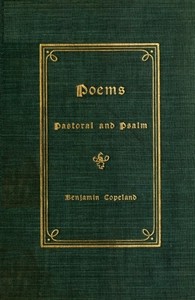
The catalog record for Poems: Pastoral and Psalm — Reading Companion provides practical reading context through 9,859 words, 43 min estimated reading time, and 3 detected text sections.
The text analysis averages about 16.9 words per sentence, while the detected sections provide another way to judge how the source is divided.
Project Gutenberg metadata also associates the work with “American poetry -- 19th century,” connecting these edition facts with the source record’s subject description.
Explore this collection
These alternatives are selected using recorded categories and estimated reading time.
About 41 minutes
Historical Psychological Social Fiction
9,362 recorded words. 2 minutes difference from this book's estimate.
View Gutenberg source #47055About 38 minutes
Historical Psychological Social Fiction
8,606 recorded words. 5 minutes difference from this book's estimate.
View Gutenberg source #38898About 53 minutes
Historical Psychological Social Fiction
12,094 recorded words. 10 minutes difference from this book's estimate.
View Gutenberg source #59474Search stored excerpts and compare books → Choose by your preferences →
Choices use stored catalog measurements. Estimates vary with reading speed. A shared category is a catalog label, not a claim that two books have the same argument or literary quality.
Search reads excerpt text stored with this catalog and links to its associated Gutenberg record. The connection is stored in the site database; this tool does not recheck that every excerpt is word-for-word identical to that external record. Excerpt search does not cover every chapter and does not verify historical publication dates.
Catalog snapshot checked: 2026-09-25. Coverage: 97 public books, 97 available source excerpts.
Calculated from edition completeness, EPUB availability, text structure and catalogue metadata. Not a user rating.
Total of 100 points, scaled to a 2.5-5.0 range. Editions with an empty description or a missing EPUB file are not scored.
Public-domain source text
The source text is kept in the dedicated reader, separate from this catalogue record and its commentary.
Benjamin Copeland’s Poems: Pastoral and Psalm (1896) alternates between two distinct modes: poems that observe the natural world with precise sensory detail, and hymns that address Christ directly in the language of liturgy. The collection’s structure itself enacts a movement from the particular to the eternal, as a robin’s song or a meadow’s scent becomes a springboard for theological reflection.
The opening poem, “The First Robin,” establishes this pattern by addressing the bird as “Herald of the happy year” and “Best of priests and poets,” collapsing the distance between nature and worship. The robin’s song is described as “April rain” that “transmutest” winter into summer—a transformation that mirrors the collection’s own method of turning earthly sights into sacred meaning.
Across the collection, light and water appear as linked images of divine presence. In “The Meadow Air Is Sweet,” dew fills a cowslip “More full than it can hold,” while a stream “cheers the lea” and flows toward the sea. These images of abundance and movement recur in the psalm-like poems: “Light of Light” calls Christ “the soul’s sure light,” and “All in All” addresses him as “O Dayspring from above! / O Sun, and Sea, and Mountain.” The repetition of elemental imagery—sun, sea, fountain, rain—creates a consistent symbolic vocabulary that ties the pastoral and psalm sections together.
Water imagery often carries a sense of cleansing or renewal. In “Penitential,” the speaker pleads for “Pardon, peace, and purity,” and in “Faint, Yet Pursuing,” the “Shepherd of our souls” is asked to “Comfort us in our affliction.” The natural world’s water—dew, brook, rain—becomes a figure for spiritual grace, a pattern that unifies the collection’s two halves.
Copeland frequently positions the poet—or the poetic speaker—as a mediator between the physical world and divine truth. In “The First Robin,” the bird is called “Best of priests and poets,” and its song “interpretest to Faith / The deep mystery of death.” This role is echoed in “The Meadow Air Is Sweet,” where the speaker notes that “only lovers understand / The oriole’s ecstasy,” implying that perception of nature’s meaning requires a kind of spiritual insight.
The collection’s structure reinforces this interpretive stance: the pastoral poems present scenes that the psalm poems then read theologically. “A Contrast” (from the table of contents) likely sets two experiences side by side, while “Compensation” and “Struggle and Rest” suggest a movement from earthly trial to heavenly reward. The poet’s voice consistently draws connections between what is seen and what is believed, making the act of observation itself a devotional practice.
The pastoral poems typically use third-person description or direct address to elements of nature—the robin, the meadow, the blackbird—while the psalm poems shift to second-person address to Christ. This change in grammatical person marks a tonal shift from observation to invocation. In “In the Morning, Jesus,” the repeated phrase “In the morning, Jesus, / Let me see thy face” creates a rhythm of petition, while “Penitential” opens with “At thy cross, O Christ, to thee / Low I bow the suppliant knee.”
The psalm poems also employ more formal, hymn-like structures: regular meter, rhyme, and refrains. “A Missionary Lyric” uses a call-and-response pattern (“Lamb of the riven side… / Victim and Victor, thee we adore”) that echoes congregational worship. This formal contrast between the freer, descriptive pastoral verse and the structured, liturgical psalm verse gives the collection a dynamic texture, moving between contemplation and prayer.
Several poems anchor themselves in specific seasons, using the natural cycle as a framework for spiritual reflection. “The First Robin” heralds spring and an “Easter festival”; “The Meadow Air Is Sweet” evokes late spring or early summer; and the table of contents includes “Easter Anticipated,” “Good Friday,” “The Resurrection,” and “Easter-Tide,” which together trace the liturgical calendar. This seasonal structure gives the collection a sense of progression from winter’s death to spring’s rebirth, mirroring the Christian narrative of crucifixion and resurrection.
Even poems not explicitly seasonal often reference time’s passage. “Midnight and Morning” suggests a movement from darkness to light, while “The Seasons Are Thy Servants” (from the contents) personifies the seasons as agents of divine will. The collection’s final poems, such as “The Consummation” and “All Saints,” look toward an end of time, completing the arc from natural cycle to eternal rest.
Copeland’s collection rewards readers who attend to its structural patterning: the way a robin’s song becomes a type of sermon, or how a meadow’s sweetness prefigures heavenly joy. The poems are best read in sequence, as the movement from pastoral observation to psalm-like prayer creates a cumulative effect of ascent. Readers interested in nineteenth-century devotional poetry or the intersection of nature writing and hymnody will find here a compact, coherent example of both traditions.
I kept thinking about how Copeland’s robins and meadowlarks feel less like scenery and more like quiet prayers you stumble onto. That same lingering stillness lives inside Poems — Story, Setting & Ideas, only the hymns are softer, more hesitant. It reminded me of mornings when the light through the trees says something you can’t quite put into words, so you just sit with it awhile.
Answer a few questions and save a private reflection on this device.