About 145 minutes
Selected Poems of Francis Thompson — Background and Themes
Science Fiction Utopias
33,133 recorded words. 10 minutes difference from this book's estimate.
View Gutenberg source #41215
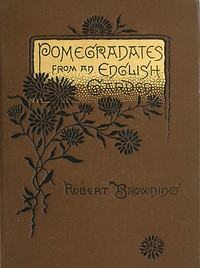
Before opening Pomegranates from an English Garden A selection from the poems of Robert Browning — Background and Themes, the edition data offers a quick orientation: 35,601 words, 2 hr 35 min estimated reading time, and 31 detected text sections.
The text analysis averages about 25.9 words per sentence, while the detected sections provide another way to judge how the source is divided.
Project Gutenberg metadata also associates the work with “English poetry,” connecting these edition facts with the source record’s subject description.
Explore this collection
These alternatives are selected using recorded categories and estimated reading time.
About 145 minutes
Science Fiction Utopias
33,133 recorded words. 10 minutes difference from this book's estimate.
View Gutenberg source #41215About 191 minutes
Science Fiction Utopias
43,720 recorded words. 36 minutes difference from this book's estimate.
View Gutenberg source #54148About 87 minutes
Science Fiction Utopias
19,883 recorded words. 68 minutes difference from this book's estimate.
View Gutenberg source #60142Search stored excerpts and compare books → Choose by your preferences →
Choices use stored catalog measurements. Estimates vary with reading speed. A shared category is a catalog label, not a claim that two books have the same argument or literary quality.
Search reads excerpt text stored with this catalog and links to its associated Gutenberg record. The connection is stored in the site database; this tool does not recheck that every excerpt is word-for-word identical to that external record. Excerpt search does not cover every chapter and does not verify historical publication dates.
Catalog snapshot checked: 2026-09-25. Coverage: 97 public books, 97 available source excerpts.
Calculated from edition completeness, EPUB availability, text structure and catalogue metadata. Not a user rating.
Total of 100 points, scaled to a 2.5-5.0 range. Editions with an empty description or a missing EPUB file are not scored.
Public-domain source text
The source text is kept in the dedicated reader, separate from this catalogue record and its commentary.
John Monro Gibson's 1885 selection of Robert Browning's poems opens with a striking metaphor: the poet's work is a pomegranate, its rough rind needing to be 'cut deep down the middle' to reveal a 'heart within, blood-tinctured, of a veined humanity.' Gibson uses this image to defend Browning's often rugged and unconventional style, arguing that it stems from 'utter freedom from affectation' rather than deliberate obscurity. The editor positions himself as a guide for readers who may have only known Browning as the author of 'The Pied Piper of Hamelin,' urging them to look beyond the forbidding exterior.
Gibson's introduction is notable for its defensive yet confident tone. He acknowledges that Browning's form is 'often, unquestionably, rough and forbidding,' but compares its charm to 'wild mountain scenery' rather than a cultivated garden. The editor explicitly rejects the charge of affectation, citing Buffon's aphorism that 'le style est l'homme même' to argue that Browning's peculiarities are natural to him. This framing shapes the entire volume: Gibson is not merely presenting poems but advocating for a particular way of reading them—one that values strength over polish and sincerity over convention.
Gibson's notes repeatedly emphasize Browning's dramatic method. In his commentary on a poem described as spoken in the poet's 'true person,' he contrasts it with Browning's usual 'dramatic in principle' works. The editor draws attention to a 'wonderful moon illustration' based on the astronomical fact that the moon always presents the same face to Earth, using it as a metaphor for revelation. This attention to structural and imagistic detail—such as identifying the 'hinge' of 'Saul' in a single line—reveals Gibson's interest in how Browning builds meaning through form and pacing.
The selection from 'Saul' is presented as a fragment, with Gibson preparing the reader by describing the poem's narrative arc: David's progression through various musical attempts to soothe King Saul, culminating in a 'high key where full relief is found.' The editor notes that stanza 16, a single line, serves as the poem's hinge. In the excerpted passage, David's invocation for help—'Still help me, who then at the summit of human endeavour'—shifts the poem from recollection to urgent prayer, altering its pace dramatically. Gibson's framing highlights how Browning uses rhythmic and syntactic shifts to mirror emotional crisis.
Gibson's edition is best approached as a guided reading rather than a comprehensive collection. His notes, while occasionally prescriptive, offer a contemporary Victorian perspective on Browning's difficulty. Readers may find it useful to read the poems first, then return to Gibson's commentary to see how his interpretations compare with their own. The volume's focus on Christian themes in the final selections also reflects the editor's particular interests, which may not align with all readers' priorities.
I remember Gibson’s pomegranate—that patient cracking open of Browning’s verse to find the moist, veined humanity within. Years later, I still think of that effort as a kind of friendship, not unlike the one I feel for Poems — Key Ideas to Explore, whose margins I’ve worn thin with just a thumb, quietly glad for company that never rushes.
Save your reaction, strongest insight, and memorable passage.









