About 91 minutes
Responsibilities, and other poems — Reading Notes
Historical Psychological Social Fiction
20,853 recorded words. 19 minutes difference from this book's estimate.
View Gutenberg source #36865
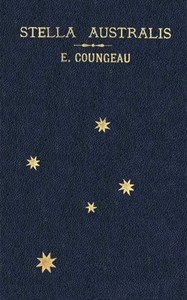
The source record for "Stella Australis": Poems, verses and prose fragments — Text and Context measures this digital text at 25,212 words, 1 hr 50 min estimated reading time, and 5 detected text sections.
The text analysis averages about 24.0 words per sentence, while the detected sections provide another way to judge how the source is divided.
Project Gutenberg metadata also associates the work with “Australian poetry,” connecting these edition facts with the source record’s subject description.
Explore this collection
These alternatives are selected using recorded categories and estimated reading time.
About 91 minutes
Historical Psychological Social Fiction
20,853 recorded words. 19 minutes difference from this book's estimate.
View Gutenberg source #36865About 132 minutes
Historical Psychological Social Fiction
30,178 recorded words. 22 minutes difference from this book's estimate.
View Gutenberg source #56521About 133 minutes
Historical Psychological Social Fiction
30,582 recorded words. 23 minutes difference from this book's estimate.
View Gutenberg source #33686Search stored excerpts and compare books → Choose by your preferences →
Choices use stored catalog measurements. Estimates vary with reading speed. A shared category is a catalog label, not a claim that two books have the same argument or literary quality.
Search reads excerpt text stored with this catalog and links to its associated Gutenberg record. The connection is stored in the site database; this tool does not recheck that every excerpt is word-for-word identical to that external record. Excerpt search does not cover every chapter and does not verify historical publication dates.
Catalog snapshot checked: 2026-09-25. Coverage: 97 public books, 97 available source excerpts.
Calculated from edition completeness, EPUB availability, text structure and catalogue metadata. Not a user rating.
Total of 100 points, scaled to a 2.5-5.0 range. Editions with an empty description or a missing EPUB file are not scored.
Public-domain source text
The source text is kept in the dedicated reader, separate from this catalogue record and its commentary.
E. Coungeau's Stella Australis (1914) moves between intimate reverie and public elegy, held together by recurring images of light, memory, and the Australian landscape. The collection opens with a poem on the death of King Edward VII, then shifts to addresses to Australia, Queensland pioneers, and the loss of the Yongala and Titanic. This alternation between personal and communal grief is a structural pattern throughout.
The prose fragments—on music, childhood, and dress—sit alongside verse, creating a hybrid form. Coungeau's voice is consistent: she favors regular rhyme and meter, and often personifies natural elements. The title, meaning "Southern Star," signals both geographic and emotional orientation.
Across the collection, Coungeau returns to images of light—gold, flame, dawn, moonlight—often in contrast with darkness or sleep. In "At Night," the speaker's spirit travels by moonlight to a childhood home, where "the moonbeams cast a halo round." The wattle is described as "a maze of gorgeous golden bloom" and "flamed" by the sun. Even in elegy, light persists: the dead king's "royal head" lies low, but the poem frames the event as a nation's soul "hung with bated breath." This binary of light and shadow structures many poems, from "Autumn" to "The Temple of the Years."
Coungeau's poems frequently shift scale from national events to personal memory. "The Loss of the 'Titanic'" and "In Memoriam: Captain Scott" sit beside "Love's Reverie" and "Because of Thee." The preface explains that the work began with a poem on King Edward's death, then expanded. This movement is not jarring but deliberate: the same voice that mourns a monarch also recalls "the olden rich perfume / Of roses clustering there" in a childhood home. The prose fragment "Scents and the Past—A Strong Connecting Link" explicitly theorizes this connection between sensory memory and emotion.
Place names anchor the collection: Cleveland, the Glasshouse Mountains, Mount Tambourine, the Blue Mountains, Mount Gambier. Coungeau treats these locations with descriptive specificity—"The Glasshouse Mountains, Queensland" and "Mount Tambourine, Queensland" are titled poems. The wattle becomes "an emblem" of national character, and Australia is addressed directly in "To Australia" and "Australia's Destiny." Yet the landscape is also a site of memory: in "At Night," the speaker returns to a house "by the sea" with "stately old elm trees" and a fountain, blending local and European imagery.
The subtitle "Poems, verses and prose fragments" accurately describes the book's structure. Five prose pieces appear among the verse: "The Ivory Temple—For Australian Women," "The Little Children—Making Good Citizens," "Music—Its Magnetic Charm," "Man and His Dress," and "So Long Ago." These are not essays but brief reflections, often didactic in tone. "Music—Its Magnetic Charm" argues for music's moral power, while "Man and His Dress" critiques fashion. Their placement suggests Coungeau saw them as complementary to the poems, extending the collection's range of voice and subject.
Readers approaching Stella Australis will find a work that rewards attention to its recurring motifs—light, memory, the Australian landscape—and to the way it moves between public elegy and private reverie. The prose fragments, though few, offer a counterpoint to the verse and hint at the author's broader interests. The collection is best read not as a unified narrative but as a series of variations on a few central themes, each poem or fragment adding a new facet.
Some evenings, returning to Stella Australis, I trace how Coungeau held light against memory—each stanza a small lantern for what fades. That same quiet reverence waits in Poems of Adoration — A Closer Reading, as if two old friends had learned the same prayer, one for the land, one for the heart. They sit together on my shelf, whispering to each other.
Save your reaction, strongest insight, and memorable passage.









