About 55 minutes
Poems — A Reader’s Guide
Fantasy Juvenile Worlds
12,471 recorded words. 0 minutes difference from this book's estimate.
View Gutenberg source #53818
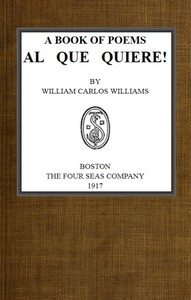
The catalog record for A Book of Poems, Al Que Quiere! — Reading Companion provides practical reading context through 12,450 words, 55 min estimated reading time, and 3 detected text sections.
The text analysis averages about 19.1 words per sentence, while the detected sections provide another way to judge how the source is divided.
Project Gutenberg metadata also associates the work with “American poetry -- 20th century,” connecting these edition facts with the source record’s subject description.
Explore this collection
These alternatives are selected using recorded categories and estimated reading time.
About 55 minutes
Fantasy Juvenile Worlds
12,471 recorded words. 0 minutes difference from this book's estimate.
View Gutenberg source #53818About 58 minutes
Fantasy Juvenile Worlds
13,338 recorded words. 3 minutes difference from this book's estimate.
View Gutenberg source #31967About 58 minutes
Fantasy Juvenile Worlds
13,251 recorded words. 3 minutes difference from this book's estimate.
View Gutenberg source #38407Search stored excerpts and compare books → Choose by your preferences →
Choices use stored catalog measurements. Estimates vary with reading speed. A shared category is a catalog label, not a claim that two books have the same argument or literary quality.
Search reads excerpt text stored with this catalog and links to its associated Gutenberg record. The connection is stored in the site database; this tool does not recheck that every excerpt is word-for-word identical to that external record. Excerpt search does not cover every chapter and does not verify historical publication dates.
Catalog snapshot checked: 2026-09-25. Coverage: 97 public books, 97 available source excerpts.
Calculated from edition completeness, EPUB availability, text structure and catalogue metadata. Not a user rating.
Total of 100 points, scaled to a 2.5-5.0 range. Editions with an empty description or a missing EPUB file are not scored.
Public-domain source text
The source text is kept in the dedicated reader, separate from this catalogue record and its commentary.
William Carlos Williams’ Al Que Quiere! (1917) opens with a speaker searching for ‘grotesque fellows’ to form a band, a declaration that sets the tone for a collection rooted in the overlooked and the ordinary. The poems that follow train attention on backstreet houses, ferryboats, and the ‘gay shadows’ of morning light. Williams’ voice is direct, often addressing a ‘you’—a solitary disciple, an old woman, or the reader—and his lines move between colloquial speech and precise observation. The catalog subjects list ‘American poetry – 20th century,’ but the excerpts show a poet deliberately turning away from the monumental toward the momentary and the marginal.
Several poems in the excerpts anchor themselves in the streets and waterways of New York and New Jersey. ‘January Morning’ offers a sequence of fifteen vignettes: a young horse with a green bed-quilt, a semicircle of men around an ash-can fire, the rickety ferry-boat ‘Arden.’ Williams records these details without moralizing, letting the images accumulate. The poem ‘Pastoral’ (the second one) declares that the speaker now ‘walk[s] back streets admiring the houses of the very poor.’ The language is stripped of ornament—‘roof out of line with sides’—and the tone is one of quiet regard rather than pity. This plain style, with its short lines and unadorned nouns, gives the urban landscape a tactile presence.
Many poems in the excerpts are structured as direct addresses. ‘Sub Terra’ calls out to ‘my grotesque fellows,’ while ‘To a Solitary Disciple’ instructs a ‘mon cher’ to notice the moon’s relation to a steeple rather than its color. ‘Dedication for a Plot of Ground’ names Emily Richardson Wellcome and recounts her biography in a single, breathless sentence. The final section of ‘January Morning’ turns to an ‘old woman,’ explaining that the poem was written so she could understand it: ‘For what good is it to me if you can’t understand it?’ This recurring concern with audience—who is being spoken to, and why—suggests a poet testing the boundaries of lyric address, moving between intimate and public registers.
Williams’ lines in these excerpts often break in unexpected places, creating a syncopated rhythm that mirrors the ‘gay shadows dropping and dropping’ he describes. In ‘Metric Figure,’ the title itself signals an interest in pattern, yet the poem’s short, irregular lines resist traditional meter. Several poems approach the epigram: ‘El Hombre’ is a single stanza of four lines; ‘Smell’ runs only six. Others, like ‘The Wanderer’ (partially excerpted), extend into longer, more discursive forms. The variety of line lengths and stanza shapes within the collection suggests a poet experimenting with how much compression a lyric can bear, and how much expansion it can sustain without losing its edge.
Readers coming to Al Que Quiere! should attend to the poems’ settings and addressees as much as to their imagery. Williams’ city is not a backdrop but a participant, and his ‘you’ is often a figure for the reader’s own attention. The collection rewards slow reading: notice where lines break, what is named and what is left out, and how the poems resist the very categories—fantasy, juvenile worlds—that the catalog assigns them.
That Williams book stayed with me—the way he watches the poor, the ferry, the plain light on ordinary streets, without turning away. It made me think of what war poems do with suffering, holding it close rather than explaining it. I found that same quiet patience in Great Poems of the World War — Key Ideas to Explore. Some lines just sit inside you afterward.
Save your reaction, strongest insight, and memorable passage.









