About 187 minutes
Milton: Minor Poems — Key Ideas to Explore
Historical Psychological Social Fiction
42,940 recorded words. 7 minutes difference from this book's estimate.
View Gutenberg source #31706
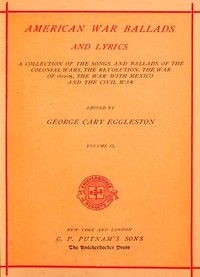
American War Ballads and Lyrics, Volume 2 (of 2) A Collection of the Songs and Ballads of the Colonial Wars, the Revolutions, the War of 1812-15, the War with Mexico and — Text and Context can be approached with a clearer sense of reading commitment from its source measurements: 41,343 words, 3 hr estimated reading time, and 9 detected text sections.
The text analysis averages about 20.2 words per sentence, while the detected sections provide another way to judge how the source is divided.
Project Gutenberg metadata also associates the work with “War poetry, American,” connecting these edition facts with the source record’s subject description.
Explore this collection
These alternatives are selected using recorded categories and estimated reading time.
About 187 minutes
Historical Psychological Social Fiction
42,940 recorded words. 7 minutes difference from this book's estimate.
View Gutenberg source #31706About 159 minutes
Historical Psychological Social Fiction
36,438 recorded words. 21 minutes difference from this book's estimate.
View Gutenberg source #44444About 154 minutes
Historical Psychological Social Fiction
35,207 recorded words. 26 minutes difference from this book's estimate.
View Gutenberg source #52601Search stored excerpts and compare books → Choose by your preferences →
Choices use stored catalog measurements. Estimates vary with reading speed. A shared category is a catalog label, not a claim that two books have the same argument or literary quality.
Search reads excerpt text stored with this catalog and links to its associated Gutenberg record. The connection is stored in the site database; this tool does not recheck that every excerpt is word-for-word identical to that external record. Excerpt search does not cover every chapter and does not verify historical publication dates.
Catalog snapshot checked: 2026-09-25. Coverage: 97 public books, 97 available source excerpts.
Calculated from edition completeness, EPUB availability, text structure and catalogue metadata. Not a user rating.
Total of 100 points, scaled to a 2.5-5.0 range. Editions with an empty description or a missing EPUB file are not scored.
Public-domain source text
The source text is kept in the dedicated reader, separate from this catalogue record and its commentary.
The second volume of George Cary Eggleston's anthology focuses on the Civil War, gathering poems that range from well-known pieces like Whittier's 'Barbara Frietchie' to lesser-known works such as 'The Old Sergeant' and 'Keenan's Charge.' The collection's narrative voice shifts markedly: some poems adopt a colloquial, almost journalistic tone, while others employ formal, elevated diction. For instance, 'John Burns of Gettysburg' presents its hero through rustic details—'a bright-blue coat with a rolling collar' and a 'bell-crowned hat'—and records the soldiers' slangy banter ('How are you, White Hat?'). In contrast, 'Woman's War Mission' uses imperative, solemn address: 'Fold away all your bright-tinted dresses.' This juxtaposition of registers within a single war context is a distinctive feature of the anthology.
Several poems adopt a vernacular, anecdotal style that brings the battlefield close. In 'John Burns of Gettysburg,' the narrator describes the old man's coat tails 'that the country-folk called “swaller”' and records the soldiers' teasing: '“How are you, White Hat?” “Put her through!”' The poem builds from this light tone to a moment of awe, as the soldiers see in Burns 'The Past of the Nation in battle there.' The shift from jest to reverence is managed through the narrator's own changing perspective. Similarly, 'The Picket Guard' and 'The Countersign' use simple, rhythmic language to evoke the soldier's solitary watch. These pieces rely on concrete details—a hat, a rifle, a password—rather than abstract patriotism, grounding the war in tangible objects and speech.
Other poems employ a more formal, exhortatory voice. 'Woman's War Mission' opens with a series of imperatives: 'Fold away all your bright-tinted dresses, / Turn the key on your jewels to-day.' The speaker addresses women directly, urging them to 'come with your souls in your faces— / To meet the stern needs of the hour.' The poem then shifts to bedside scenes, describing wounds with clinical precision—'the blood through his sunny hair rippling / From a horrible gash in the head'—while maintaining a moralizing tone: 'These wounds are more precious than ghastly.' 'Battle Hymn of the Republic' uses biblical cadence and repetition ('Mine eyes have seen the glory'), while 'The Conquered Banner' adopts a mournful, elegiac register. This formal voice often appears in poems that frame the war as a cause or a tragedy, contrasting with the colloquial pieces that focus on individual experience.
The anthology's pacing varies dramatically. 'Sheridan's Ride' and 'The Bay Fight' use short, driving lines and exclamation to convey urgency: 'Hurrah! hurrah for Sheridan! / Hurrah! hurrah for horse and man!' In contrast, 'Driving Home the Cows' and 'After All' slow to a reflective, almost pastoral pace. 'The Old Sergeant' builds tension through incremental detail, while 'Roll-Call' and 'Reading the List' use repetition to evoke the grim routine of war. This alternation between rapid battle sequences and quiet aftermaths shapes the reader's experience, preventing monotony and highlighting the emotional range of wartime poetry. The editor's arrangement, moving from action to reflection and back, creates a rhythm that mirrors the war itself.
Readers may find it useful to compare the treatment of a single event across poems—for instance, the Battle of Gettysburg appears in 'John Burns of Gettysburg,' 'Gettysburg,' and 'At Gettysburg,' each with a different narrative focus. Noticing how voice and pacing shift between these pieces reveals the anthology's deliberate variety. The volume rewards attention to the interplay of registers, from slang to scripture, and to the way each poem selects a particular moment or figure to represent the larger conflict.
There’s a particular ache in those Civil War ballads—the way the rapid battle verses thin out into mourning, as if the music itself is catching its breath. It’s the same quiet undertow I feel drifting through the gentler, fragmented verses of "Stella Australis": Poems, verses and prose fragments — Text and Context, where the sorrow isn’t loud, just remembered, like a name spoken once and then left in the air.
Save your reaction, strongest insight, and memorable passage.









