About 188 minutes
The Cambridge Book of Poetry for Children Parts 1 and 2 — Inside the Classic
Adventure Picaresque Fiction
43,167 recorded words. 8 minutes difference from this book's estimate.
View Gutenberg source #50994
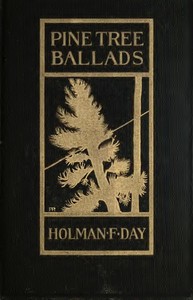
Pine Tree Ballads: Rhymed Stories of Unplaned Human Natur' up in Maine — Reading Notes can be approached with a clearer sense of reading commitment from its source measurements: 44,941 words, 3 hr 16 min estimated reading time, and 14 detected text sections.
The text analysis averages about 25.2 words per sentence, while the detected sections provide another way to judge how the source is divided.
Project Gutenberg metadata also associates the work with “Maine -- Poetry,” connecting these edition facts with the source record’s subject description.
Explore this collection
These alternatives are selected using recorded categories and estimated reading time.
About 188 minutes
Adventure Picaresque Fiction
43,167 recorded words. 8 minutes difference from this book's estimate.
View Gutenberg source #50994About 178 minutes
Adventure Picaresque Fiction
40,838 recorded words. 18 minutes difference from this book's estimate.
View Gutenberg source #61286About 162 minutes
Adventure Picaresque Fiction
37,044 recorded words. 34 minutes difference from this book's estimate.
View Gutenberg source #36954Search stored excerpts and compare books → Choose by your preferences →
Choices use stored catalog measurements. Estimates vary with reading speed. A shared category is a catalog label, not a claim that two books have the same argument or literary quality.
Search reads excerpt text stored with this catalog and links to its associated Gutenberg record. The connection is stored in the site database; this tool does not recheck that every excerpt is word-for-word identical to that external record. Excerpt search does not cover every chapter and does not verify historical publication dates.
Catalog snapshot checked: 2026-09-25. Coverage: 97 public books, 97 available source excerpts.
Calculated from edition completeness, EPUB availability, text structure and catalogue metadata. Not a user rating.
Total of 100 points, scaled to a 2.5-5.0 range. Editions with an empty description or a missing EPUB file are not scored.
Public-domain source text
The source text is kept in the dedicated reader, separate from this catalogue record and its commentary.
Holman Day’s Pine Tree Ballads announces its allegiance to vernacular voice from the title page: these are “rhymed stories of unplaned human natur’ up in Maine.” The foreword sets the tone, describing men whose “hands are blistered by plow-handle and ax” and whose “heads are as hard as the stones piled around their acres.” Day’s diction is deliberately rough-hewn, favoring dialect spellings like “hain’t,” “sartin,” and “r’arin’” that anchor the poems in a specific regional speech. The verse form—usually ballad stanzas with forced rhymes and irregular meter—mirrors the unpolished characters it portrays. What emerges is less a celebration of rustic virtue than a gallery of stubborn, cantankerous, and often comic figures, rendered with a reporter’s ear for idiom and a satirist’s eye for human foible.
Day’s primary authorial tool is the representation of Maine dialect, which he uses not merely for local color but to define personality. In “Old ‘Ten Per Cent,’” the usurer Seth is described as “yeller ’em saffron bitters’cause he’s colored so by bile”—the dropped consonants and compressed vowels signal a man whose sourness is both physical and moral. The poem’s narrator adopts the same idiom, creating a seamless world where the speaker and subject share a linguistic code. In “When ‘Lish Played Ox,” the dialogue between John Gile and Uncle ‘Lish Henderson is a contest of boasts and threats delivered in the same rough register: “I’ll tell ye right now that the oxen I own / Hain’t driven like kittens.” The dialect is not decorative; it is the medium through which power struggles, grudges, and bargains are enacted. Day’s ear for the rhythms of rural speech—the dropped final consonants, the swallowed syllables, the inverted syntax—gives each poem a distinct sonic texture.
Several ballads hinge on physical confrontation rendered with exaggerated, almost slapstick detail. In “When ‘Lish Played Ox,” the stranger John Gile responds to Uncle ‘Lish’s bullying by treating him like a real ox: he “threw out his quid and he threw down his hat,” then chases the man around the yard, jabbing him with a brad and whacking him with a goad-stick. The poem’s climax—‘Lish screaming “For heaven’s sake, stranger, let’s play I hain’t ox”—turns the threat of violence into a joke about mistaken identity. Day’s descriptions are precise: the “vicious ash stick,” the “two inches of brad” jabbed “with all of his two-handed might.” The physicality is cartoonish but grounded in the tools of farm life. Similarly, in “Old ‘Ten Per Cent,’” the minister’s rebuke to Seth uses a violent metaphor: “you’d thrown the rock—and that hain’t all! / You’d’a’ thrown one with a corner!” The humor depends on the incongruity of biblical allusion and backwoods bluntness.
“Old ‘Ten Per Cent’” offers the collection’s most sustained portrait of a type: the usurer whose heartlessness is rendered as physical deformity. Seth’s mouth is “pooched and solemn,” his complexion “yeller,” his hearing selectively deaf to all but the whisper of interest. Day piles on details: “He never hears the wailin’ of the troubled folks within, / He simply wants his money.” The poem’s structure is a series of negations—what Seth does not hear, does not feel, does not give—building to the image of a man “holler where the soul should be.” The satire is blunt, but the language is inventive: “He’s deef to ev’ry cry of want and don’t know what is meant, / But—bet he’ll hear for ha’f a mile the whisper, ‘Ten per cent!’” The exaggeration is deliberate, turning Seth into a folk devil. Yet Day avoids moralizing; the poem ends not with a lesson but with the same sardonic refrain, leaving the reader to judge.
Many ballads are framed as stories told by a local narrator, a device that distances the poet from the characters while reinforcing the sense of communal gossip. The foreword introduces the collection as “plain tales,” and the poems often begin with a direct address: “Wal, ye’d think a dig of that sort would have shamed him ha’f to death.” This oral frame allows Day to shift between reported speech and commentary, as when the narrator of “Old ‘Ten Per Cent’” interjects “Land o’ Goshen, neighbor,—hain’t no mortifyin’ Seth!” The effect is that of a yarn spun on a porch, with the teller’s asides and digressions part of the entertainment. The ballad form itself—with its repetitive refrains and end-stopped lines—mimics the rhythms of oral recitation. Day’s choices in meter and rhyme are often rough, favoring a driving beat over polish, which suits the material: these are stories meant to be heard, not studied.
Day’s ballads reward attention to the small verbal choices that define character: the way a man “pooches” his mouth, the precise sound of a goad-stick hitting flesh, the rhythm of a boast or a curse. Readers will find that the poems work best when read aloud, letting the dialect’s music and the comic timing emerge. The collection does not offer a unified portrait of Maine so much as a series of snapshots, each one a performance of voice and attitude. Approach these ballads as you would a conversation with a wry, unsentimental storyteller—one who knows his subjects too well to flatter them.
There's a particular ache in Holman Day's ballads—that stubborn Maine pride hiding a tired heart—that stays with me long after the pages close. It reminds me of evenings spent with an older book, Poems of Pleasure — Background and Themes, where the laughter feels a little closer to tears. Both know how rough living can get, yet neither looks away. That honesty, plain and unvarnished, is a quiet comfort I keep coming back to.
Your answers remain private and are stored only in this browser.









