About 19 minutes
Two Poems: Class Day Poem; The Purple Hills — Inside the Classic
Historical Psychological Social Fiction
4,184 recorded words. 8 minutes difference from this book's estimate.
View Gutenberg source #51466
For Poems — A Closer Reading, the stored edition analysis reports 5,988 words, 27 min estimated reading time, and 1 detected text section.
The text analysis averages about 25.6 words per sentence, while the detected sections provide another way to judge how the source is divided.
Project Gutenberg metadata also associates the work with “English poetry -- 20th century,” connecting these edition facts with the source record’s subject description.
Explore this collection
These alternatives are selected using recorded categories and estimated reading time.
About 19 minutes
Historical Psychological Social Fiction
4,184 recorded words. 8 minutes difference from this book's estimate.
View Gutenberg source #51466About 38 minutes
Historical Psychological Social Fiction
8,606 recorded words. 11 minutes difference from this book's estimate.
View Gutenberg source #38898About 41 minutes
Historical Psychological Social Fiction
9,362 recorded words. 14 minutes difference from this book's estimate.
View Gutenberg source #47055Search stored excerpts and compare books → Choose by your preferences →
Choices use stored catalog measurements. Estimates vary with reading speed. A shared category is a catalog label, not a claim that two books have the same argument or literary quality.
Search reads excerpt text stored with this catalog and links to its associated Gutenberg record. The connection is stored in the site database; this tool does not recheck that every excerpt is word-for-word identical to that external record. Excerpt search does not cover every chapter and does not verify historical publication dates.
Catalog snapshot checked: 2026-09-25. Coverage: 97 public books, 97 available source excerpts.
Calculated from edition completeness, EPUB availability, text structure and catalogue metadata. Not a user rating.
Total of 100 points, scaled to a 2.5-5.0 range. Editions with an empty description or a missing EPUB file are not scored.
Public-domain source text
The source text is kept in the dedicated reader, separate from this catalogue record and its commentary.
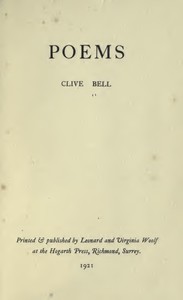
Clive Bell's Poems (1921) opens with 'The Card House,' a short piece in which a builder's careful structure collapses at a clap. The poem's tone—'One had to titter, willy-nilly'—immediately establishes a voice that is wry and self-aware. The preface explains that most of these seventeen poems first appeared in periodicals like The Nation and New Statesman, and that a dozen were privately printed in 1917 as Ad Familiares. This edition, issued by the Hogarth Press, makes Bell's work available to a wider audience.
The collection begins with 'The Card House' (1912), a fable-like poem about effort and collapse. The builder 'laughed to see how well it stood,' but his shout proves 'over-daring,' and the house topples. The poem's moral is left implicit, but the final couplet—'One had to titter, willy-nilly, / To see him look so sad and silly'—suggests a blend of sympathy and amusement. This sets a pattern: Bell often observes human folly with a light touch.
'Letter to a Lady I' (1913) shifts to Venice, where the speaker waits for change while pondering 'What lacks when sea and sky conspire.' The poem is dense with specific details: the Salute church, the Giudecca canal, a 'conto of 12.50.' Bell's voice is conversational, even gossipy, as he mentions 'Ignatius Chowne / And J. A. Symonds.' The setting is not merely decorative; it anchors the speaker's mood of listless waiting.
Several poems in the middle of the collection are titled by months: 'March,' 'April,' 'June,' 'October,' 'December.' These are not nature lyrics in the Romantic mode. Instead, they treat seasonal change as a backdrop for social observation. In 'March,' the speaker notes the 'tweed-coated, winter-hosed' figures caught by 'precocious summer.' The poems often pivot between the personal and the general, as in 'Reply to Mrs. Jowitt,' which responds to a specific correspondent.
Bell's verse is metrically varied, from the tetrameter of 'The Card House' to the looser lines of 'Letter to a Lady I.' He frequently uses rhyme for comic effect, as in 'Sometimes, austere philosopher, / I scan what thought reveals: / At other times I much prefer / Silk stockings and high heels.' This couplet from the final poem, 'ΠΑΝΤΩΝ ΓΛΥΚΥΤΑΤΩΝ ΜΕΤΑΒΟΛΗ,' encapsulates his willingness to juxtapose high and low.
As the collection progresses, Bell's poems become more explicitly philosophical. 'The Last Infirmity' and 'To Lopokova Dancing' engage with art and mortality. In the latter, the dancer is addressed as 'that mystery, / That still life that just lies / Below the surface.' The imagery of water—'the stream goes by,' 'green weeds blow'—suggests hidden depths. Yet Bell resists solemnity; the poem's final lines mock 'our dull inquisition that would know / What life is, what you are.'
The closing poem, 'ΠΑΝΤΩΝ ΓΛΥΚΥΤΑΤΩΝ ΜΕΤΑΒΟΛΗ' (Greek for 'change is the sweetest of all things'), is a direct statement of Bell's aesthetic. The speaker declares, 'Frankly, I do not greatly care / Always to be my best.' He prefers variety: 'blondes and browns and grief and mirth / And, above all things, Change.' This poem serves as a capstone, justifying the collection's tonal shifts.
Bell's poems are addressed to a specific circle. 'Letter to a Lady I' and 'Letter to a Lady II' are epistolary; 'To A.V.S. with a Book' and 'To Gerald Shove' name individuals. The preface mentions that the 1917 edition was distributed 'amongst my friends,' and that 'curious amateurs' have since requested copies. This context explains the poems' occasional quality: they are witty, allusive, and assume a reader familiar with Bloomsbury references.
The voice is consistently urbane. Bell uses colloquial phrases ('it is strange,' 'I'm waiting still') and self-deprecation ('my vanity is outraged'). He is not a confessional poet; his emotions are filtered through irony. The poems reward attention to their formal craft—rhyme schemes, enjambment, and metrical variation—rather than emotional intensity. Readers should approach them as performances of intelligence and charm.
Bell's Poems are best read as a sequence, not a miscellany. The opening and closing poems frame a journey from playful construction to philosophical acceptance of change. The middle poems, with their seasonal titles and social addresses, fill out a portrait of a mind that is both observant and detached. Readers unfamiliar with the Hogarth Press or Bloomsbury coteries will still find pleasure in Bell's wit and formal skill. The poems invite re-reading: their lightness conceals a careful architecture.
Somewhere between the playful irony of Bell’s Card House and his quieter lyric about change, I found myself thinking of that other slim volume, the one that lingers on the turf of youth and purple hills. Both feel like afternoons spent sifting through old letters—half-remembered, half-fresh. This one sits beside it nicely: Two Poems: Class Day Poem; The Purple Hills — Inside the Classic. A soft, familiar ache, that’s all.
Save your reaction, strongest insight, and memorable passage.









