About 27 minutes
Poems — A Closer Reading
Historical Psychological Social Fiction
5,988 recorded words. 8 minutes difference from this book's estimate.
View Gutenberg source #60237
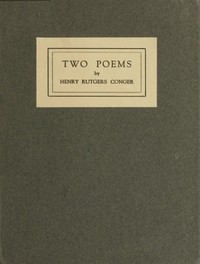
This digital edition of Two Poems: Class Day Poem; The Purple Hills — Inside the Classic is described by source-level measurements including 4,184 words, 19 min estimated reading time, and 1 detected text section.
The text analysis averages about 24.9 words per sentence, while the detected sections provide another way to judge how the source is divided.
Project Gutenberg metadata also associates the work with “College verse, American -- Massachusetts -- Williamstown,” connecting these edition facts with the source record’s subject description.
Explore this collection
These alternatives are selected using recorded categories and estimated reading time.
About 27 minutes
Historical Psychological Social Fiction
5,988 recorded words. 8 minutes difference from this book's estimate.
View Gutenberg source #60237About 38 minutes
Historical Psychological Social Fiction
8,606 recorded words. 19 minutes difference from this book's estimate.
View Gutenberg source #38898About 41 minutes
Historical Psychological Social Fiction
9,362 recorded words. 22 minutes difference from this book's estimate.
View Gutenberg source #47055Search stored excerpts and compare books → Choose by your preferences →
Choices use stored catalog measurements. Estimates vary with reading speed. A shared category is a catalog label, not a claim that two books have the same argument or literary quality.
Search reads excerpt text stored with this catalog and links to its associated Gutenberg record. The connection is stored in the site database; this tool does not recheck that every excerpt is word-for-word identical to that external record. Excerpt search does not cover every chapter and does not verify historical publication dates.
Catalog snapshot checked: 2026-09-25. Coverage: 97 public books, 97 available source excerpts.
Calculated from edition completeness, EPUB availability, text structure and catalogue metadata. Not a user rating.
Total of 100 points, scaled to a 2.5-5.0 range. Editions with an empty description or a missing EPUB file are not scored.
Public-domain source text
The source text is kept in the dedicated reader, separate from this catalogue record and its commentary.
Henry Rutgers Conger's Two Poems, printed posthumously in 1921 by his Williams College classmates, opens with a formal, almost ceremonial address. The Class Day Poem adopts a first-person plural voice—'We, who have lived together'—that immediately establishes a collective speaker. This choice frames the poem as a shared farewell, not an individual lament. The mother figure, Williams College, is personified with 'stately and tall' attributes, her voice 'rings clear and slow,' delivering a blessing that occupies the bulk of the poem. Conger's diction shifts between the intimate ('kneel for our mother’s blessing') and the imperative ('Listen! that I may tell you'), creating a tension between reverence and urgent instruction.
Conger gives the college a commanding maternal persona. The mother 'speaks the words of the blessing' in 'simple speech and plain,' yet her language is laced with moral weight. She demands an accounting: 'Masters of many talents / Render account to me.' This echoes the parable of the talents, but Conger adapts it to an academic context. The mother's authority is absolute—she calls the graduates 'sons of my four years’ nurture' and warns against pride: 'Are ye puffed with the pride of learning?' The repetition of 'ye' throughout her speech (eleven times in the excerpt) lends a biblical, archaic tone, reinforcing her role as a moral arbiter. The personification is consistent: the college has 'eyes' with 'light of infinite knowledge' and a 'voice' that is both tender and stern. This choice transforms an institution into a living, judging presence.
The Class Day Poem employs a regular ABAB rhyme scheme and alternating lines of iambic tetrameter and trimeter. This ballad-like meter gives the poem a rhythmic, almost chant-like quality, suitable for oral delivery at a class day ceremony. Conger occasionally breaks the pattern for emphasis: the line 'He that is strong shall conquer! He that is weak must die!' uses a spondaic opening ('He that') and a caesura, creating a stark, proverbial force. The rhyme pairs are often simple ('sky/good-by,' 'few/do'), but Conger also uses more resonant rhymes like 'delight/right' and 'legacy/me.' In The Purple Hills, the meter shifts to a looser iambic pentameter with occasional anapests, reflecting a more meditative tone. The contrast in formal structure between the two poems suggests a deliberate shift from public exhortation to private reflection.
Conger's vocabulary in the mother's speech is dominated by images of competition and combat. The world is a place where 'men fight hard with men,' governed by a 'great law' of survival: 'He that is strong shall conquer! He that is weak must die!' This Darwinian language is striking in a poem meant to bless graduates. The mother warns that 'untaught men shall shame you / In the open market-place,' and that graduates must 'bear your parts in the battle.' The word 'master' recurs: 'every man is your master / Until you have mastered him.' Conger avoids sentimental encouragement; instead, he emphasizes struggle and merit. The 'sheltered life of college' is contrasted with a 'journey, down' from the 'quiet heart of the mountains' into a 'careless' world. This downward trajectory—from elevation to the plain—reinforces the poem's theme of leaving a protected space for a harsh reality.
While the Class Day Poem is dominated by the mother's voice and martial imagery, The Purple Hills (based on the title and catalog subject 'College verse, American -- Massachusetts -- Williamstown') likely turns to landscape as a central figure. The catalog entry notes Williams College's location in Williamstown, and the poem's title suggests the Berkshire hills. Conger's earlier poem uses the mountains as a point of departure—'From the quiet heart of the mountains / Ye must take journey, down'—but The Purple Hills may linger on the hills themselves as symbols of permanence or memory. The shift from the imperative, collective voice of the Class Day Poem to a more personal, descriptive mode is evident in the title's focus on color ('Purple') and natural form. Without full text, one can infer that Conger employs a different register: less rhetorical, more lyrical. The two poems together thus offer a contrast between public duty and private attachment to place.
Readers approaching Two Poems should attend to the distinct voices Conger crafts: the collective 'we' of the Class Day Poem versus the implied solitary speaker of The Purple Hills. The formal structure—rhymed quatrains versus likely blank verse—signals different occasions and audiences. The mother's speech, with its blend of blessing and warning, rewards close attention to its biblical and competitive diction. These poems, though brief, reveal a poet negotiating the transition from college to the wider world, using personification, meter, and imagery to articulate that passage.
That grey afternoon, the rain kept time with Conger’s measured lines until I noticed how his diction curved around a quiet ache, never naming it. The editorial notes felt like someone’s margin scribbles, a hand reaching across decades. Later, thumbing through remembered passages, I found myself drawn to Poems — A Closer Reading, which sat unopened on the shelf, its presence suddenly friendlier, like old tobacco and damp wool.
Your answers remain private and are stored only in this browser.









