About 36 minutes
Poems — Background and Themes
Fantasy Juvenile Worlds
8,162 recorded words. 3 minutes difference from this book's estimate.
View Gutenberg source #51554
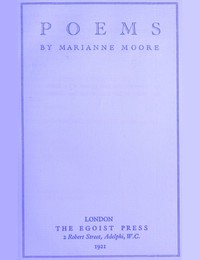
Poems — Text and Context can be approached with a clearer sense of reading commitment from its source measurements: 7,501 words, 33 min estimated reading time, and 25 detected text sections.
The text analysis averages about 29.0 words per sentence, while the detected sections provide another way to judge how the source is divided.
Project Gutenberg metadata also associates the work with “American poetry -- 20th century,” connecting these edition facts with the source record’s subject description.
Explore this collection
These alternatives are selected using recorded categories and estimated reading time.
About 36 minutes
Fantasy Juvenile Worlds
8,162 recorded words. 3 minutes difference from this book's estimate.
View Gutenberg source #51554About 40 minutes
Fantasy Juvenile Worlds
9,139 recorded words. 7 minutes difference from this book's estimate.
View Gutenberg source #61598About 23 minutes
Fantasy Juvenile Worlds
5,244 recorded words. 10 minutes difference from this book's estimate.
View Gutenberg source #36094Search stored excerpts and compare books → Choose by your preferences →
Choices use stored catalog measurements. Estimates vary with reading speed. A shared category is a catalog label, not a claim that two books have the same argument or literary quality.
Search reads excerpt text stored with this catalog and links to its associated Gutenberg record. The connection is stored in the site database; this tool does not recheck that every excerpt is word-for-word identical to that external record. Excerpt search does not cover every chapter and does not verify historical publication dates.
Catalog snapshot checked: 2026-09-25. Coverage: 97 public books, 97 available source excerpts.
Calculated from edition completeness, EPUB availability, text structure and catalogue metadata. Not a user rating.
Total of 100 points, scaled to a 2.5-5.0 range. Editions with an empty description or a missing EPUB file are not scored.
Public-domain source text
The source text is kept in the dedicated reader, separate from this catalogue record and its commentary.
Marianne Moore's Poems (1921) opens with 'Pedantic Literalist,' a portrait of a figure who 'invite[s] destruction' through a 'carved cordiality' that becomes an 'obstruction to the motive that it served.' The poem's dense, ironic voice immediately establishes Moore's characteristic method: she uses precise, often surprising images—a 'Prince Rupert's drop,' a 'paper muslin ghost'—to dissect human behavior. The collection then moves through a series of sharp, compact lyrics that test the boundaries of praise and critique.
The first several poems establish a pattern of address and rebuke. 'To a Steam Roller' dismisses a mind that 'crush[es] all the particles down into close conformity,' while 'Diligence Is to Magic as Progress Is to Flight' praises a figure who 'chose to travel laboriously' on an elephant rather than a magic carpet. These poems share a tone of cool, analytical judgment, often using animals or objects as foils for human failings. The speaker's voice is authoritative but not dogmatic, leaving room for the reader to question the terms of the critique.
In 'Poetry,' Moore famously admits, 'I too, dislike it,' then argues for a poetry that contains 'the genuine'—'hands that can grasp, eyes that can dilate, hair that can rise if it must.' She champions the useful over the 'high sounding interpretation,' and insists on 'imaginary gardens with real toads in them.' This poem serves as a key to the collection's aesthetic: Moore values concrete, observable phenomena—'the bat, holding on upside down,' 'elephants pushing'—over abstract or derivative expression. The poem's own structure, with its enjambed lines and parenthetical asides, enacts this preference for the raw and the real.
'Dock Rats' offers a vivid counterpoint to the earlier, more critical poems. Here, the speaker describes a harbor scene with affectionate precision: 'the square-rigged four-master, the liner, the battleship, like the two-thirds submerged section of an iceberg.' The sensory details—the smell of apples when the wind is from the east, the sight of a parrakeet 'clasping and clawing'—accumulate into a portrait of a place where 'shipping is the most congenial thing in the world.' This poem suggests that Moore's critical eye can also yield delight, and that her attention to the particular is not merely analytical but also celebratory.
'Radical' presents a carrot as a 'wedge-shaped engine' that 'conserv[es] everything' and 'breed[s] monopoly.' The poem's form—tapering lines, compressed syntax—mirrors its subject's 'secret of expansion.' Moore's use of enjambment and hyphenation ('belligerent- ly,' 'pre- determined') creates a visual and rhythmic tension that enacts the carrot's internal pressure. The final lines, 'that which it is impossible to force, it is impossible to hinder,' offer a gnomic conclusion that resists easy interpretation. This poem exemplifies Moore's ability to find moral and philosophical resonance in the most ordinary objects.
Reading Moore's Poems sequentially reveals a poet who is both a sharp critic and a keen observer of the world's textures. The early poems' ironic addresses give way to later pieces that embrace the 'genuine' in nature and urban life. Pay attention to how Moore's formal choices—her line breaks, her use of quotation, her sudden shifts in tone—create meaning. The collection rewards rereading, as its compressed language and unexpected juxtapositions yield new insights with each encounter.
I found myself drifting back to Moore’s Poems the other evening, especially the way she lingers on a single, stubborn detail. That quiet patience reminded me of another collection I once carried — Sonnets and Canzonets — Key Ideas to Explore — where form feels less like a cage and more like a held breath. Both seem to trust the small, honest thing.
Save your reaction, strongest insight, and memorable passage.









