About 33 minutes
Poems — Text and Context
Fantasy Juvenile Worlds
7,501 recorded words. 3 minutes difference from this book's estimate.
View Gutenberg source #62833
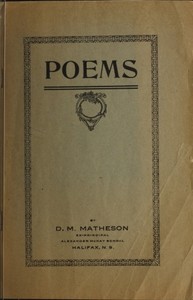
This digital edition of Poems — Background and Themes is described by source-level measurements including 8,162 words, 36 min estimated reading time, and 2 detected text sections.
The text analysis averages about 31.3 words per sentence, while the detected sections provide another way to judge how the source is divided.
Project Gutenberg metadata also associates the work with “World War, 1914-1918 -- Poetry,” connecting these edition facts with the source record’s subject description.
Explore this collection
These alternatives are selected using recorded categories and estimated reading time.
About 33 minutes
Fantasy Juvenile Worlds
7,501 recorded words. 3 minutes difference from this book's estimate.
View Gutenberg source #62833About 40 minutes
Fantasy Juvenile Worlds
9,139 recorded words. 4 minutes difference from this book's estimate.
View Gutenberg source #61598About 48 minutes
Fantasy Juvenile Worlds
10,814 recorded words. 12 minutes difference from this book's estimate.
View Gutenberg source #32477Search stored excerpts and compare books → Choose by your preferences →
Choices use stored catalog measurements. Estimates vary with reading speed. A shared category is a catalog label, not a claim that two books have the same argument or literary quality.
Search reads excerpt text stored with this catalog and links to its associated Gutenberg record. The connection is stored in the site database; this tool does not recheck that every excerpt is word-for-word identical to that external record. Excerpt search does not cover every chapter and does not verify historical publication dates.
Catalog snapshot checked: 2026-09-25. Coverage: 97 public books, 97 available source excerpts.
Calculated from edition completeness, EPUB availability, text structure and catalogue metadata. Not a user rating.
Total of 100 points, scaled to a 2.5-5.0 range. Editions with an empty description or a missing EPUB file are not scored.
Public-domain source text
The source text is kept in the dedicated reader, separate from this catalogue record and its commentary.
D. M. Matheson's Poems (1916) opens with a celebration of Nova Scotian autumn—'Indian Summer'—before turning to the battlefields of Flanders and the Somme. The collection moves between pastoral description and war reportage, with a notable shift in register: the same poet who writes 'Fair are fleets of white winged prows' also writes 'Life is but one darn thing after another.' This juxtaposition of formal, often archaic diction with colloquial, even sardonic phrasing is the collection's most distinctive authorial choice.
Matheson's diction varies sharply between poems. In 'Indian Summer,' he uses elevated, Latinate phrases: 'Fair are fleets of white winged prows' and 'Gift of Architect divine.' The same poet, in 'Life Is But One Darn Thing After Another,' adopts a deliberately flat, prosaic tone: 'Whether you cry from grief or smile with laughter.' The title itself—a near-proverb—signals a break from the hymnal register of 'Mother Love' or 'The Soul of Flanders.' This range suggests a poet self-consciously moving between public, patriotic utterance and private, wry observation. The war poems, such as 'Courcellette,' revert to a more conventional ballad stanza, with lines like 'Early on an autumn morning, / Facing famous Courcellette,' while 'An Elegy Written In Richmond' uses a more meditative, personal voice. The effect is a collection that feels uneven by design, as if Matheson is testing which voice fits the subject.
Matheson favors regular meter and rhyme. Most poems use iambic tetrameter or pentameter, with consistent ABAB or AABB rhyme schemes. 'Indian Summer' is built on a repeating 'Fair are...' anaphora, creating a litany-like effect. 'Courcellette' and 'Vimy Ridge' use a four-beat line with alternating rhymes, typical of narrative ballads. The most structurally unusual poem is 'Life Is But One Darn Thing After Another,' which uses a repeated refrain line and a tight ABABCCB rhyme scheme across three stanzas. This poem's formal regularity contrasts with its conversational content. 'An Elegy Written In Richmond' adopts a looser, more discursive structure, with stanzas of varying length and a first-person speaker who reflects on the Halifax Explosion. The shift from tight ballad form to freer elegy suggests Matheson adapting his craft to different emotional registers.
Two landscapes dominate: the idealized Nova Scotian countryside and the scarred fields of France and Belgium. 'Indian Summer' and 'Petoobok' describe Acadia in terms of 'wooded lakes,' 'headlands high,' and 'golden sea,' using natural imagery as a baseline of peace. The war poems invert this: 'Courcellette' places soldiers 'In the trenches damp and wet' near 'the far-famed river Somme,' while 'Vimy Ridge' describes 'the terrane and the trenches' torn 'with lead and steel.' The contrast is explicit in 'The Gardens' and 'Keep The Gardens Growing,' where the garden metaphor for England or Canada is set against the 'mangled faces' of the dead in 'An Elegy Written In Richmond.' Matheson also uses specific place names—Courcellette, Vimy Ridge, Langemarc—as anchors for his battle narratives, grounding abstract patriotism in named locations.
Matheson shifts between a collective 'we' and a personal 'I.' In 'Courcellette' and 'Vimy Ridge,' the speaker is an observer or chronicler of the battalion's actions: 'Word the Twenty-fifth was given / To make ready for the fray.' The perspective is external, focusing on the group. In 'An Elegy Written In Richmond,' the speaker becomes a first-person witness to the Halifax Explosion: 'And ever see the blinded lying low / At Bellevue, Camp Hill, and College Hall.' This poem includes a direct address to God: 'My Lord, my God, I yet have faith in Thee.' The most personal voice appears in 'Life Is But One Darn Thing After Another,' where the speaker generalizes from experience: 'This you will find until life’s cord will sunder.' The variety suggests Matheson trying on different roles—public bard, private mourner, philosophical observer—without settling on one.
Readers should note that the excerpts represent about half the collection; the full text includes poems not quoted here, such as 'Edith Cavell' and 'To Cardinal Mercier.' The range of subjects—from a Mi'kmaq place name ('Petoobok') to the Halifax Explosion—indicates a poet engaged with both local and international events. Pay attention to how Matheson handles transitions between formal and informal registers; these shifts may reveal more about his intentions than any single poem does alone.
I was thinking about how Poems — Background and Themes carries those quiet, wry moments between battlefield thunder, and it made me recall another old volume, one that lingers on the same uneasy silences. The way Matheson catches a soldier’s half-smile beside the elegy feels like a door left ajar. That other book, Great Poems of the World War — Key Ideas to Explore, seems to wait on the same threshold.
Save your reaction, strongest insight, and memorable passage.









