About 43 minutes
poems of yes and no — Key Ideas to Explore
Science Fiction Utopias
9,741 recorded words. 5 minutes difference from this book's estimate.
View Gutenberg source #58080
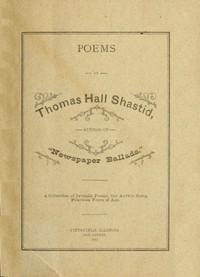
The catalog record for Poems — Inside the Classic provides practical reading context through 8,727 words, 38 min estimated reading time, and 2 detected text sections.
The text analysis averages about 21.7 words per sentence, while the detected sections provide another way to judge how the source is divided.
Project Gutenberg metadata also associates the work with “American poetry -- 19th century,” connecting these edition facts with the source record’s subject description.
Explore this collection
These alternatives are selected using recorded categories and estimated reading time.
About 43 minutes
Science Fiction Utopias
9,741 recorded words. 5 minutes difference from this book's estimate.
View Gutenberg source #58080About 31 minutes
Science Fiction Utopias
7,000 recorded words. 7 minutes difference from this book's estimate.
View Gutenberg source #30842About 47 minutes
Science Fiction Utopias
10,622 recorded words. 9 minutes difference from this book's estimate.
View Gutenberg source #35497Search stored excerpts and compare books → Choose by your preferences →
Choices use stored catalog measurements. Estimates vary with reading speed. A shared category is a catalog label, not a claim that two books have the same argument or literary quality.
Search reads excerpt text stored with this catalog and links to its associated Gutenberg record. The connection is stored in the site database; this tool does not recheck that every excerpt is word-for-word identical to that external record. Excerpt search does not cover every chapter and does not verify historical publication dates.
Catalog snapshot checked: 2026-09-25. Coverage: 97 public books, 97 available source excerpts.
Calculated from edition completeness, EPUB availability, text structure and catalogue metadata. Not a user rating.
Total of 100 points, scaled to a 2.5-5.0 range. Editions with an empty description or a missing EPUB file are not scored.
Public-domain source text
The source text is kept in the dedicated reader, separate from this catalogue record and its commentary.
Thomas Hall Shastid was fourteen when he published Poems in 1881, but many pieces in this collection were written even earlier. The preface thanks editors for encouragement and launches the volume onto “the wide sea of literature.” The poems that follow show a young author working through inherited forms—hymnal stanzas, ballad quatrains, blank verse—while testing contrasts between peace and violence, joy and loss, light and shadow.
The author’s age is not merely a biographical note; it shapes the verse’s ambitions and limitations. “Christmas Night” opens with a familiar carol refrain—“Be peace on earth, good will to men”—and closes with a direct address to the reader: “He died for me, He died for thee.” The poem moves from manger to crucifixion in four stanzas, compressing theology into simple couplets. In contrast, “Solferino” attempts blank verse across six stanzas, describing a battle with “the deafening rolling cannon’s roar” and “the dying’s groan.” The shift from hymnal regularity to unrhymed iambic pentameter signals an effort to match form to subject, even if the execution is uneven.
Several poems build around stark visual contrasts. “The Spectres” personifies Sorrow and Envy as figures “clad in blackness” who chase away “each ray of light.” “The Rain Storm” juxtaposes “bold electric flashes” with “patter, patter” rain drops, finding music in the storm. “In Spring Time” celebrates “the warm sunshine” but warns that “the cold gray winter will ravish our joys.” This pattern of brightness threatened by darkness recurs across the collection, often tied to moral choices: in “A Dream,” a path “leading down to hell” is set against “the brighter way.” The imagery is consistent enough to suggest a deliberate thematic thread rather than accidental repetition.
“The Last Drink” tells a compact story: an old drunkard enters a dram-shop, sees the bar-keeper’s daughter “in a dress of purest white,” thinks of his own “shoeless and cold and ragged” child, and uses his dime to buy bread instead of drink. The poem ends with the drunkard reformed and his family happy. The moral is explicit, but the detail is specific—the white dress, the dime, the winter setting. Similarly, “Falling of the Apple Tree” mourns a lost tree with concrete observations: “the blossoms sparkled ere it fell,” “the wind sings through the leaves.” These domestic scenes ground the collection’s more abstract moralizing in tangible, remembered objects.
Readers approaching this volume should attend to the interplay between the author’s youth and his formal choices. The poems are short, often repetitive in imagery, and openly didactic. Yet the consistency of certain motifs—light versus darkness, peace versus war, the specific loss of a tree or a child—gives the collection a coherence that transcends its occasional awkwardness. The blank-verse experiment “Solferino” stands apart in subject and structure, offering a glimpse of the poet reaching beyond his usual range.
That rainy afternoon, nestled under a worn blanket, I lingered on Shastid's childhood Christmas carols, their simple awe echoing in the quiet patter against the glass. The softness stayed with me long after I closed the book, leading me to another shelf, where I found Hymns and Poems — Text and Context, and the same gentle stillness seemed to dwell there, unhurried and familiar.
Build a private reading journal entry for this title.









