About 87 minutes
The Magic House, and Other Poems — Themes and Context
Fantasy Juvenile Worlds
19,786 recorded words. 8 minutes difference from this book's estimate.
View Gutenberg source #52898
The source record for The Bells, and Other Poems — Reading Notes measures this digital text at 18,149 words, 1 hr 19 min estimated reading time, and 3 detected text sections.
The text analysis averages about 26.2 words per sentence, while the detected sections provide another way to judge how the source is divided.
Project Gutenberg metadata also associates the work with “Fantasy poetry, American,” connecting these edition facts with the source record’s subject description.
Explore this collection
These alternatives are selected using recorded categories and estimated reading time.
About 87 minutes
Fantasy Juvenile Worlds
19,786 recorded words. 8 minutes difference from this book's estimate.
View Gutenberg source #52898About 71 minutes
Fantasy Juvenile Worlds
16,196 recorded words. 8 minutes difference from this book's estimate.
View Gutenberg source #56037About 69 minutes
Fantasy Juvenile Worlds
15,761 recorded words. 10 minutes difference from this book's estimate.
View Gutenberg source #33486Search stored excerpts and compare books → Choose by your preferences →
Choices use stored catalog measurements. Estimates vary with reading speed. A shared category is a catalog label, not a claim that two books have the same argument or literary quality.
Search reads excerpt text stored with this catalog and links to its associated Gutenberg record. The connection is stored in the site database; this tool does not recheck that every excerpt is word-for-word identical to that external record. Excerpt search does not cover every chapter and does not verify historical publication dates.
Catalog snapshot checked: 2026-09-25. Coverage: 97 public books, 97 available source excerpts.
Calculated from edition completeness, EPUB availability, text structure and catalogue metadata. Not a user rating.
Total of 100 points, scaled to a 2.5-5.0 range. Editions with an empty description or a missing EPUB file are not scored.
Public-domain source text
The source text is kept in the dedicated reader, separate from this catalogue record and its commentary.
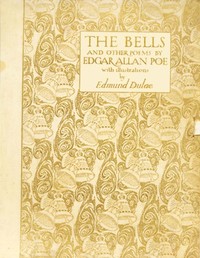
Edmund Dulac's 1912 edition of The Bells, and Other Poems pairs Edgar Allan Poe's verse with elaborate color plates that interpret rather than merely illustrate. The collection opens with the title poem, where Poe's onomatopoeic 'tintinabulation' and shifting meters—from silver bells' 'tinkle, tinkle' to brazen bells' 'shriek, shriek'—create a sonic arc from merriment to terror. Dulac's three plates for 'The Bells' echo this progression, moving from crystalline winter scenes to fiery chaos. The volume includes 35 poems, from the well-known 'The Raven' to lesser pieces like 'Al Aaraaf,' offering a cross-section of Poe's lyrical range.
Poe's 'The Bells' is a study in acoustic mimicry. The poem's four sections each adopt a distinct bell type—silver, golden, brazen, iron—and a corresponding mood: merriment, happiness, terror, solemnity. The diction shifts accordingly: 'jingling and tinkling' gives way to 'screaming' and 'shrieking,' then to 'moaning and groaning.' The repetition of 'bells, bells, bells' mimics the relentless tolling, while the irregular line lengths and internal rhymes ('swells' / 'dwells' / 'tells') create a hypnotic, almost musical pattern. Dulac's illustrations for the poem capture these tonal shifts: the first plate shows a moonlit sleigh ride, the second a wedding scene, the third a fire engulfing a tower. The visual narrative reinforces the poem's descent from joy to despair.
Dulac's illustrations for this volume are characterized by rich color, intricate detail, and a tendency toward the fantastical. In 'Annabel Lee,' the lovers are depicted in a moonlit seascape, the maiden's hair flowing like seaweed, while the kingdom by the sea is rendered as a dreamlike castle. For 'The Raven,' Dulac chooses a moment of stillness: the raven perched on a bust of Pallas, the scholar slumped in his chair, shadows pooling around them. The palette is muted—deep blues, greys, and blacks—contrasting with the brighter hues of 'Eldorado' and 'The City in the Sea.' Dulac's style, influenced by Persian miniatures and Art Nouveau, often frames scenes with ornate borders or decorative elements, as in 'Al Aaraaf,' where the text is surrounded by floral motifs and celestial figures.
Across the collection, Poe returns to a cluster of themes: the death of a beautiful woman ('Annabel Lee,' 'Lenore,' 'To One in Paradise'), the haunting power of memory ('Dreams,' 'A Dream within a Dream'), and the boundary between life and death ('The Sleeper,' 'Ulalume'). The language is consistently elevated, with archaic diction ('thee,' 'thou,' 'hath') and formal inversions. In 'The Conqueror Worm,' the metaphor of life as a play watched by angels culminates in the worm's victory, a grim image of mortality. Dulac's plate for this poem shows a skeletal figure in a theatrical setting, reinforcing Poe's fusion of spectacle and terror. The poems often employ a first-person speaker whose grief or obsession drives the narrative, as in 'The Raven,' where the protagonist's dialogue with the bird reveals his descent into madness.
While Poe is best known for his dark, rhythmic poems, this collection also includes lighter pieces. 'Eulalie—A Song' celebrates a love that transforms the speaker's world, with lines like 'Ah, less—less bright the stars of the night / Than the eyes of the radiant girl!' 'To Helen' (the shorter version) praises classical beauty, while 'The Lake—To——' finds solace in nature's solitude. Even in these poems, however, a note of melancholy persists: 'Eulalie' ends with the speaker's 'soul' growing 'faint' with joy, and 'The Lake' describes a 'terror' that is 'not fright, / But a tremulous delight.' Dulac's illustrations for these poems often soften the mood—'To Helen' shows a serene classical figure—but the text retains Poe's characteristic tension between ecstasy and dread.
Readers approaching this edition should attend to the interplay between Poe's sound patterns and Dulac's visual choices. The poems reward reading aloud, especially 'The Bells' and 'Ulalume,' where rhythm carries emotional weight. Dulac's plates are best examined after reading each poem, as they offer interpretive glosses rather than literal depictions. This volume provides a compact survey of Poe's poetic methods, from the musical to the macabre, and invites comparison between the verbal and visual arts.
Dulac’s Poe makes me think of how sound can carry a kind of ache—those bells that ring on past the poem. I found a similar echo in Ledwidge’s quieter music, where the fields remember their own losses. There’s a gentle sorrow in The Complete Poems of Francis Ledwidge with Introductions by Lord Dunsany — A Closer Reading that stays with you, like a bell heard from far off.
Build a private reading journal entry for this title.









