About 58 minutes
Graded Poetry: Third Year — Reading Companion
Fantasy Juvenile Worlds
13,338 recorded words. 1 minutes difference from this book's estimate.
View Gutenberg source #31967
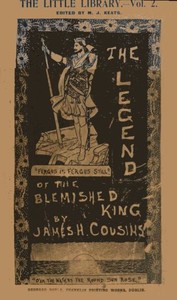
The catalog record for The legend of the blemished king, and other poems — Key Ideas to Explore provides practical reading context through 13,495 words, 59 min estimated reading time, and 3 detected text sections.
The text analysis averages about 24.4 words per sentence, while the detected sections provide another way to judge how the source is divided.
Project Gutenberg metadata also associates the work with “English poetry -- Irish authors,” connecting these edition facts with the source record’s subject description.
Explore this collection
These alternatives are selected using recorded categories and estimated reading time.
About 58 minutes
Fantasy Juvenile Worlds
13,338 recorded words. 1 minutes difference from this book's estimate.
View Gutenberg source #31967About 58 minutes
Fantasy Juvenile Worlds
13,251 recorded words. 1 minutes difference from this book's estimate.
View Gutenberg source #38407About 55 minutes
Fantasy Juvenile Worlds
12,450 recorded words. 4 minutes difference from this book's estimate.
View Gutenberg source #51997Search stored excerpts and compare books → Choose by your preferences →
Choices use stored catalog measurements. Estimates vary with reading speed. A shared category is a catalog label, not a claim that two books have the same argument or literary quality.
Search reads excerpt text stored with this catalog and links to its associated Gutenberg record. The connection is stored in the site database; this tool does not recheck that every excerpt is word-for-word identical to that external record. Excerpt search does not cover every chapter and does not verify historical publication dates.
Catalog snapshot checked: 2026-09-25. Coverage: 97 public books, 97 available source excerpts.
Calculated from edition completeness, EPUB availability, text structure and catalogue metadata. Not a user rating.
Total of 100 points, scaled to a 2.5-5.0 range. Editions with an empty description or a missing EPUB file are not scored.
Public-domain source text
The source text is kept in the dedicated reader, separate from this catalogue record and its commentary.
The title poem, 'The Legend of the Blemished King,' opens with a prologue and four cantos, but the excerpts provide only the table of contents and an editor's note, not the poem itself. What is available is the complete 'The Legend of Saint Mahee of Endrim,' a narrative of an angel-bird that sings three songs, each spanning a hundred years, while the saint stands entranced. The poem's closing stanzas shift to a broader meditation on ruins, war, and the passage of time, ending with a question about 'echoes from the songs of old.' This structure—legend followed by reflective commentary—recurs in the collection, where mythological subjects often yield to contemporary concerns.
The excerpts show Cousins using legendary material not merely for escapism but as a vantage point to critique his own era. In 'The Legend of Saint Mahee of Endrim,' after the saint's three-century trance, the poem abruptly turns to 'De Courcey's marshalled hosts' and 'rude sea-rovers,' then to 'the hate of sects, the clutching claws' of modern strife. The transition from a miraculous bird to 'pessimistic wail' and 'promissory gleams' suggests a deliberate juxtaposition: the ancient tale becomes a lens for examining contemporary decay and hope. Similarly, 'A Song of Decadence' (listed in the contents) likely continues this thread, though its text is not excerpted. The catalog subject 'English poetry -- Irish authors' is accurate, but the secondary tag 'fantasy-folklore' underplays the collection's critical edge; these are not pure fantasies but poems that use folklore to interrogate modern life.
Cousins employs varied metrical forms across the collection. 'The Legend of Saint Mahee of Endrim' uses a ballad-like alternating tetrameter and trimeter, with occasional dimeter lines ('Fast and even faster'), creating a driving, oral quality. In contrast, the editor's note (included in the excerpts) discusses Wordsworth's sonnet on the sonnet form, implying that Cousins himself engaged with stricter forms. The contents list includes sonnets like 'On the Death of William Morris' and 'To Algernon Charles Swinburne,' suggesting a formal range from narrative verse to lyric. The voice shifts accordingly: the saint's legend is told with a storyteller's simplicity ('Thus he spake to one who faced him'), while the later stanzas adopt a more rhetorical, almost prophetic tone ('What tho' the thousands, born to fail'). This variety indicates a poet conscious of tradition but willing to adapt it to different subjects.
Throughout the excerpts, images of light and dawn recur, often in contexts of hope or transition. In 'Saint Mahee,' the sun 'sparkles in the brine' over 'shattered shrine,' and the poem speaks of 'some broad-beamed and brighter morn' and 'tempest-cradled calm.' The word 'dawn' appears multiple times: 'the dawn doth give / Some promissory gleams' and 'flowers the dawn / To still ignoble days.' The sea is another constant—'Strangford's waters wide,' 'the brine,' 'sea-rovers'—anchoring the poems in an Irish coastal landscape. These images are not merely decorative; they structure the poems' arguments about time and renewal. The 'dawn' that promises change is also the dawn that 'flowers to still ignoble days,' a tension that runs through the collection. The catalog subject 'fantasy-folklore' might lead a reader to expect otherworldly settings, but the excerpts ground the fantastic in concrete, natural imagery.
Readers approaching this collection should note that the excerpts represent only a portion of the whole. The title poem and several others are absent, so judgments about the book's overall arc remain provisional. Pay attention to how Cousins balances narrative and reflection, and to the way his Irish settings—both real and legendary—serve as a stage for broader questions about progress, faith, and art. The poems reward attention to their formal craft and their willingness to let ancient stories speak to modern discontents.
There’s a particular hush in Cousins’ Legend of the Blemished King that lingers—the sense of ruins holding their secrets politely. It reminded me, oddly, of finding old marginalia in another volume, The Bells, and Other Poems — Reading Notes, where someone had underlined “time’s slow forgiveness” and left it at that. Both feel like letters not quite meant for me, yet left open anyway.
Answer a few questions and save a private reflection on this device.









